The article doesn’t talk about the fact that the increase is far greater in dark conditions, which is not readily explained by the changes to car design the article discusses.
This article talks more about that, and the linked report suggests population trends have contributed to more people walking at night along arterial roads with poor pedestrian infrastructure.
To be clear, daytime fatalities are up by about 40% in the interval shown, which is much more than the increase in population. Increasing vehicle size and hood height are real problems too, but don’t seem to be the biggest factor.
There are sidewalks on both sides of the street in my neighborhood. People are walking 2 abreast in the street at night and joggers are commonly running about 4 feet into the street from the curb.
Regardless of the article’s findings, some people are just oblivious.
What is the condition of your sidewalks? My sidewalks are uneven and a neighborhood grandma who I walk with still prefers the street even though my street is not well lit. Uneven sidewalks are a tripping hazard that can be avoided by walking in the street. Her vision isn’t great so a paved stretch of road is just easier to walk with a flashlight.


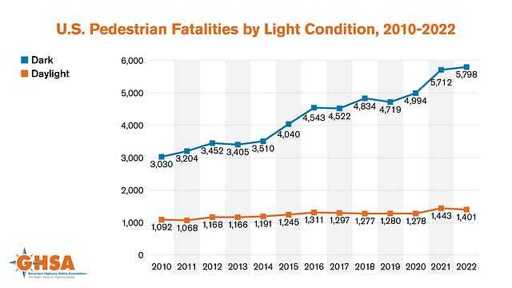
The article doesn’t talk about the fact that the increase is far greater in dark conditions, which is not readily explained by the changes to car design the article discusses.
This article talks more about that, and the linked report suggests population trends have contributed to more people walking at night along arterial roads with poor pedestrian infrastructure.
To be clear, daytime fatalities are up by about 40% in the interval shown, which is much more than the increase in population. Increasing vehicle size and hood height are real problems too, but don’t seem to be the biggest factor.
There are sidewalks on both sides of the street in my neighborhood. People are walking 2 abreast in the street at night and joggers are commonly running about 4 feet into the street from the curb.
Regardless of the article’s findings, some people are just oblivious.
What is the condition of your sidewalks? My sidewalks are uneven and a neighborhood grandma who I walk with still prefers the street even though my street is not well lit. Uneven sidewalks are a tripping hazard that can be avoided by walking in the street. Her vision isn’t great so a paved stretch of road is just easier to walk with a flashlight.
Top tip: don’t hit them.
I knew someone who did that because the sidewalks were too uneven. She had bad ankles and kept rolling them trying to walk in the sidewalk
Since pandemic I’ve fallen twice because of bad sidewalks. It’s embarrassing as shit