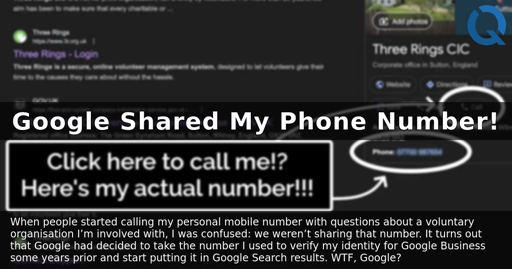
When people started calling my personal mobile number with questions about a voluntary organisation I'm involved with, I was confused: we weren't sharing that number. It turns out that Google had decided to take the number I used to verify my identity for Google Business some years prior and start putting it in Google Search results. WTF, Google?


I understand the story is about google adding a guy’s number to a business profile, which seems very odd. But I wonder if anybody here is old enough to remember phone books? I haven’t seen one in a while, but in the landline era the phone company used to automatically deliver one to everybody who had a phone. A large physical book with the name, address and phone number of everybody in the local area, except people who paid extra to be unlisted. If you didn’t want to look somebody up in the book you could dial a number and a helpful operator would tell you their phone number so you could call them. This was totally normal and didn’t bother anybody - how do people feel about that whole concept now?
With social media, e-mail, and the rest of it “out there” people have started assuming that “unlisted” is the default for voice phones now. Also, in those “good old days” of the ubiquitous phone books, the listings were mostly land-lines, and mobile phones were unlisted by default. Because of the rates charged for mobile calls in the dying days of the white pages, there were even special laws regarding unsolicited calls to your mobile phone.
It used to be difficult AND expensive to get an unlisted domain name as well, but that has been evolving and now it’s a no-cost checkbox option when registering whether you want your contact info to be listed with the domain ownership or not.
Times do change, and while we are generally more exposed than ever, I believe the shifts to more “private by default” configurations of our contact info are a good thing.
Its weird how more people decided to use this information against people in the modern era than people in the past.
It was used against people in the past too, probably more underreported then than now.
It’s like having 100,000 yellow pages books. In the days of old you might be able to switch cities if you were trying to evade a stalker. Now you’ll have to change your name, face, and accent.
You can still pay for lookup services. I got a 1-month subscription recently to contact the mom of a friend who disappeared. All I had was the guy’s last name and the town he said his mom lived in. Cost 7 or 8 bucks but it was worth it. So anyway I imagine a stalker wouldn’t need a ton of resources to track a person down using pay services.
If you know the town then in the old days you could go there and get a yellow pages. But your point is valid, because there’s so many other privacy concerns this one is a drop in the bucket. I’m much more scared of the government watching me through my neighbor’s ring cameras just because I said Luigi Mangione is innocent on Lemmy (which he totally is). Or that Elon Musk told us he’s a Nazi sympathizer and I’m repeating what he said, neutrally.