awh comon I just installed it for the first time, what’s wrong with Manjaro?
Don’t worry, it’s just the open-source version of the market correcting. There’s no stock, no venture capital. If the group putting in time and effort to help maintain something doesn’t like how the project is being run, they take a copy and start over with a new name. It’s happened countless times on OS, it’ll happen countless more. Often, the existing leadership is burned out, some of the more active members move on, and those left through attrition lack the skills to keep it going. The forks generally move forward faster and cleaner with more active people. Other than needing to change distros, it’s pretty much a win.
It’s not so much that the distro is bad, but the leadership of the project, according to a lot of the community working on it, is very unresponsive, bad at administration, doesn’t make decisions that need to be made in a timely manner and not really doing their job. The community basically wants to cut them out and move on.
I wouldn’t necessarily say it’s bad, but I don’t use it because:
- The project’s had a history of failing at really basic administrative tasks like keeping their ssl certificate up to date
- I’m unconvinced they actually do the testing that justifies the delays and not just using arch. This is because security patches sometimes also get delayed and issues have gotten past the delay
- They’ve accidentally DDoSed the aur multiple times by shipping broken versions of pamac when fixed versions were available
- I’ve seen complaints about leadership and how they handle finances, though I haven’t really looked into this
But at least they lost all that weight. Good for them.
Hi, I’m an AI engineer based in Japan, and I’m expanding into the U.S. market to work with more long-term clients. I’m looking for an American collaborator who can act as a communication bridge between me and U.S. clients.
I will handle the technical side myself, including project planning, AI development, and software implementation. Your role would be to join meetings, help with smooth communication, and support the client relationship side.
If this sounds like a good fit, please send me a message.
Burn it down
This is why I’m going to argue for pure Arch or Artix. Ultimately, what a lot of these distros bring to the table is artwork. But they bite off a lot more than artwork when doing so. And in time they can start to suck at that administration.
It’s not very hard to set up your system with a vanilla DE and adjust it into something good. You don’t need to get fancy. And to the extent someone else’s art work can be good and accelerate getting to a nice system, there are other ways to distribute that.
You should want your distro to be 95% administration and 5% art because in the long run that’s whats going to keep your system stable and avoid future headaches. But some artists are overly ambitious and envision creating an entire version of an operating system, including the parts they aren’t passionate about. And some people buy in on this premise and install these projects. …instead of just releasing dot files.
For it to go well requires that both the leadership and the contributors are passionate about all of the parts and passionate about them forever. Not very likely. If you want a distro that is administered well, get a distro where administration is all they do, and then get your artwork as a separate selection.
Now you can get your art from artists who put 95% of their effort into art. And your package stability by people who put 95% of their effort into package stability.
Everyone has romantic feelings toward a system that is integrated. But what they should realize is that integrated and modular are opposites. And modular is what they should want, with effective roll separation.
If they fork Majaro that is good. If when they fork it they scope down to just distribute a dot file set, and maybe create their own easy installer for Arch that isn’t a seperate whole distro, that is better.
Looks like a decent plan. I’ll have no problem with supporting non-profit
The fact that CachyOS more or less successfully replaced Manjaro’s purpose I guess is evidence of Manjaro’s issues.
I forgot but I think Bazzite had similar complaints (due to its use of silverblue) in which case it was just more straightforward to use Fedora or OpenSUSE if you don’t want to work with the read only root system.
Downstream distros need to bring additional value to the table to be worth using, otherwise there’s really no need if you can make a package group that accomplishes the same thing in one go.
I had been using Pop-os for about a year but wasn’t completely happy with it. A friend suggested Bazzite and, to me, it was a lot better in some ways and worse in others. I’ve since switched to Fedora and don’t really have any complaints. I don’t plan on switching again baring something I don’t see coming.
Did I just find next distro to try? :) Kudos to them anyway (yay, that’s the kind of news I want to hear)
Doesn’t look like it. But the project will now go to the to-be-founded non-profit association.
Philm actually replied around the time of your comment, sharing his disdain that this plan was set in motion, while as company owner he has no one to talk to legally, since the association has not been founded yet. He’s supportive of the move, and technically he’s right. The association should’ve already been founded, to be fair.
I hope this means Manjaro will thrive!
Manjaro will become even less well maintained because the people working on it will spend their time managing this crisis instead of doing productive work on the distro.
as an outsider, reading the forum discussion, the split is not the crisis, the crisis is already ongoing, and the split from the company is actually a step towards a good solution. Also, the discussion tone seems to be very constructive.

Good for them! A second TLS problem after what happened last time is unacceptable. I hope the ‘mutiny’ succeeds.
Pretty sure this wasn’t the second
And even that was only the most visible yet surface level one of their problems.
It wasn’t.
A significant portion of the Manjaro team has signed a manifesto demanding the project split from its parent company and restructure as a non-profit.
Sourav Rudra 18 Mar 2026
Manjaro has long been one of the more popular Arch-based Linux distributions, known for making Arch Linux more accessible to everyday users. But it has been losing ground for years, both in terms of user trust and active contributors, and the complaints about its direction have only gotten louder.
Now, things have hit a breaking point, with calls for a fork if the current leadership does not budge.
A Manjaro team member going by the handle “Aragorn” has published the “Manjaro 2.0 Manifesto” on the official Manjaro forum. The post lays out a detailed restructuring plan for the project that has been signed by 19 team members, including developers, community managers, moderators, and the company’s technical lead.
Is there any weight behind this?
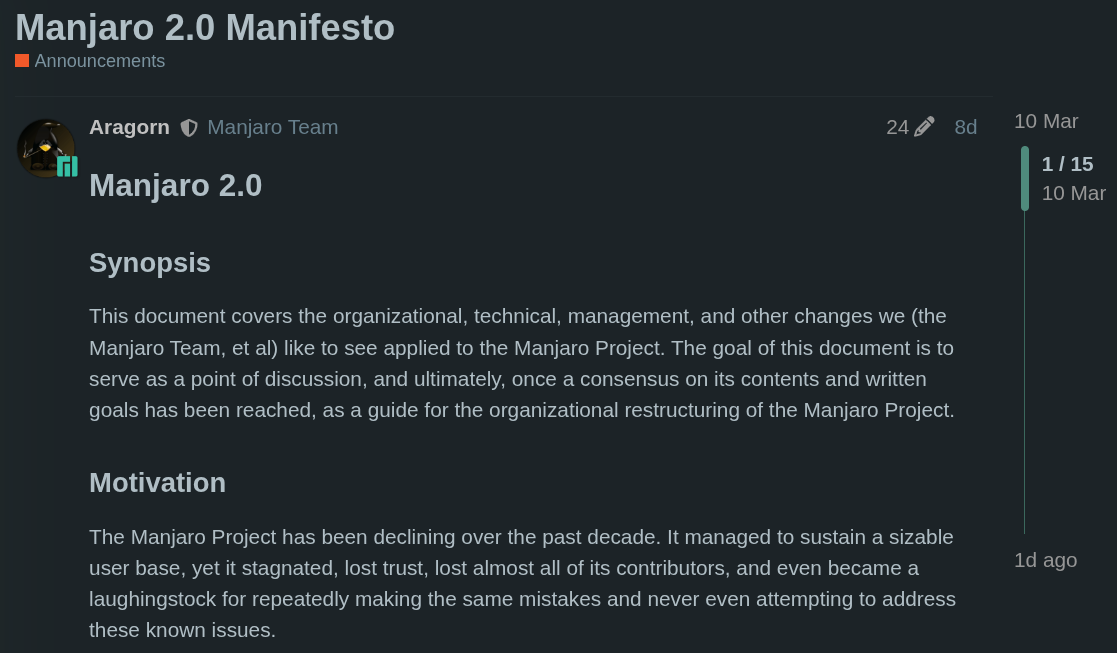 The manifesto opens by stating that the Manjaro Project has been declining over the past decade, losing trust and contributors while repeating the same mistakes without ever addressing them.
One example cited is the repeated failure to keep TLS certificates current, something volunteers had reportedly already built tooling to fix, only to be ignored.
From there, it goes after the core issue directly. Aragorn writes that Philip Müller (the project lead) has been running Manjaro as his own personal venture rather than a community effort, keeping a tight hold on access to both the codebase and the infrastructure.
Aragorn goes on to say that:
The priorities of the Project leadership do not align with those of the developers and community. The current leadership’s goal is to turn Manjaro into a successful business, and thus far, these attempts have mostly failed.
The money situation makes it worse. The manifesto says the company, Manjaro GmbH & Co KG, has not been funneling any of its funds back into the project and has not pursued outside funding either. **What the team wants is a clean separation, where the Manjaro Project is spun off from Manjaro GmbH & Co. KG and restructured as a registered nonprofit association under German law (e.V.).
The new structure would distribute ownership equally among members, use transparent voting for major decisions, and assign “arbiter” roles to experienced contributors for specific domains.
Under the proposal, the nonprofit would get full use of the Manjaro trademark through 2029. The company keeps the right to use it too, as long as the two don’t step on each other’s toes. After that initial period, the manifesto nudges the company to declare that it is willing to hand over full trademark ownership to the nonprofit for €1.
Key assets like the GitHub organizations, the self-hosted GitLab instance, forum, CDN, and the manjaro.org domain would all move over to the non-profit as well. **The team has also laid out what would happen if they were ignored. The “Our Resolve” section of the manifesto says that there are three stages (from 0-2): waiting for a reply, striking and going public, and finally forking or leaving. Within Stage 1, there are three phases that control how public the document gets.
They skipped Phase 2 and jumped straight to Phase 3 a few days ago, moving the manifesto to the public Announcements section of the forum and archiving the thread on archive.org. If things don’t improve, then a forum lockdown is on the table. **Don’t think that this is some kind of witch hunt. One of the Manjaro team members, Dennis ten Hoove, has clarified that the goal of this initiative is not to kick people off the project but to change the leadership and help foster Manjaro as a healthy community-driven project.
Expect a bumpy transition
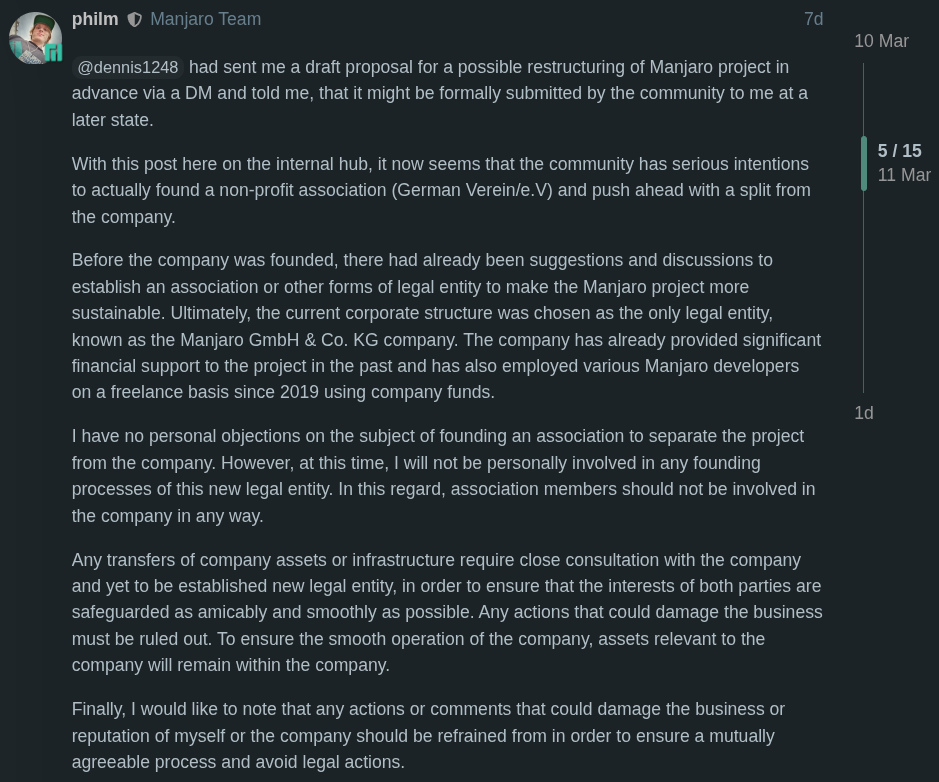 Philip did break his silence on the matter, saying that he is fine with an association being formed but wants no part in setting one up himself. He also made clear that handing over any assets would need to happen on the company’s terms and closed with a warning that public statements damaging to either himself or the business could have legal consequences.
The protesting team’s response was measured, where Aragorn pushed back, pointing out that the manifesto already lets the company continue using the infrastructure for as long as it needs to move its operations elsewhere.
Roman Gilg, who signed the manifesto despite being the company’s CTO, put a direct question to Philip, asking whether he had any specific objection to the list of assets outlined in the document. Philip went quiet again.
After days of silence on that question, Aragorn declared that Philip was stalling and announced the team was skipping Phase 2 and moving straight to Phase 3 (where things stand as of now).
What can you do?
There’s an active community discussion thread with over 200 replies, started specifically to accommodate talks surrounding the manifesto. If you have thoughts on what’s going wrong with the Manjaro project and what could be done better, you can head over and weigh in.
One of the Manjaro old timers, Stefano Capitani, has recently posted there, sharing his view of the situation:
I have to apologize to all of you. It seems I’ve missed some of the events here. I believe, without fear of contradiction, that I, along with @guinux , @oberon , and of course @philm, am one of the “old timers” still active, if not as much as before, but still active in Manjaro.
I have to be honest, I feel like I’m having flashbacks because we’ve already had these discussions or “storms” in the past. We’ve always come out stronger, and we’ll come out stronger this time too.
PS: You need to be logged in to the Manjaro forum to view user profiles.
Thank you for writing this up, as someone not familiar with what’s going on over there I really appreciate you taking the time.
Thanks, but I didn’t write anything – I just copy pasted the linked article – maybe it is not what the website would want, but I much prefer reading the article in the comments vs having to click the link to read the article.
Raises an interesting philosophical and operational point about how content online should be paid for.
Just let it die. So much time and energy wasted
The new structure would distribute ownership equally among members, use transparent voting for major decisions, and assign “arbiter” roles to experienced contributors for specific domains

So… Open Manjaro?
Mandrake is a name that has freed up.
Ooooh!!!
Manjourno
 “Manjourno”
Personjaro
Manjaro?
No. Womanjaro.
No…
Theyjaro
WEJARO!
Now we’re circling back to Ubuntu, which means “together”.
its a garbage distro
They need to cast out the person who can’t renew the ssl certificate.
Who renews certificates these days? You automate that now, especially with 47 day certs coming.
Riot Games recently screwed it and downed LoL for a while
My renewals have been running in a crontab for five years without any hiccups. The fact they can’t do that is simply lazy.
That’s the level of incompetency that needs to be booted
I moved back to a debian based distro and it’s basically the same. Doesn’t really matter which one you use
LMDE is pretty good, and I have a reasonable amount of trust in the Mint team to keep it on track