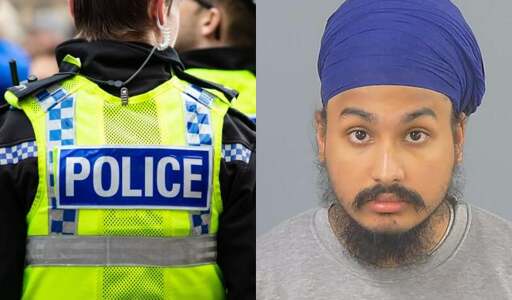
British police faced backlash on Tuesday over the case of an 18-year-old student who was handcuffed as he lay dying from stab wounds after his killer falsely alleged a racist attack.
Can’t tell you how it is in the UK, but here in Germany, you’re only allowed to carry knives with short blades (<= 8 cm, IIRC) in public, anything larger than that has to be stowed away safely, so that it cant be reached easily. A locked container would be ideal, but the precise definition is a bit wishy washy, and there are also designated areas, where even the small ones are not allowed (or fall under the same restrictions. I’m not really sure).
Furthermore, there are knives, which are just generally outlawed depending on their construction; like spring-loaded knives and butterfly knives, for example.
If there are at least similar regulations in the UK, the Sikh’s ceremonial daggers, could fall into a category that would usually be banned, but with an exemption for religious reasons.
Some of the rules here are a bit silly, imho, but the fact, that we don’t treat a small paring knife the same as an army combat knife at least makes sense to me.
Swiss army knives are also permitted in most places thanks to their lack of locking mechanism, iirc there’s a specific law in place about locking knives of any length, but I’m not going to trawl through pages of constabularyspeak to find out.
In Germany the law regarding foldable knives is summed up as such:
If it can be opened with one hand AND is lockable, it’s banned, regardless of length.
It can be lockable, or it can be opened with one hand, but not both of these features at the same time.
But that doesn’t lead to a general permission.
Other restrictions might apply as well, due to some other characteristics. There’s just a specific ban for lockable knives with a one-handed opening mechanism.
And since there are varying sizes and features of Swiss army knives, you’d have to judge them based on the specific model.
But again: this is specific to Germany. Even different EU countries have sometimes very different laws.


Can’t tell you how it is in the UK, but here in Germany, you’re only allowed to carry knives with short blades (<= 8 cm, IIRC) in public, anything larger than that has to be stowed away safely, so that it cant be reached easily. A locked container would be ideal, but the precise definition is a bit wishy washy, and there are also designated areas, where even the small ones are not allowed (or fall under the same restrictions. I’m not really sure).
Furthermore, there are knives, which are just generally outlawed depending on their construction; like spring-loaded knives and butterfly knives, for example.
If there are at least similar regulations in the UK, the Sikh’s ceremonial daggers, could fall into a category that would usually be banned, but with an exemption for religious reasons.
Some of the rules here are a bit silly, imho, but the fact, that we don’t treat a small paring knife the same as an army combat knife at least makes sense to me.
That makes sense. Good to know I probably haven’t been doing anything illegal by carrying a swiss army knife in the S Bahn
Swiss army knives are also permitted in most places thanks to their lack of locking mechanism, iirc there’s a specific law in place about locking knives of any length, but I’m not going to trawl through pages of constabularyspeak to find out.
In Germany the law regarding foldable knives is summed up as such: If it can be opened with one hand AND is lockable, it’s banned, regardless of length.
It can be lockable, or it can be opened with one hand, but not both of these features at the same time.
But that doesn’t lead to a general permission. Other restrictions might apply as well, due to some other characteristics. There’s just a specific ban for lockable knives with a one-handed opening mechanism. And since there are varying sizes and features of Swiss army knives, you’d have to judge them based on the specific model.
But again: this is specific to Germany. Even different EU countries have sometimes very different laws.