

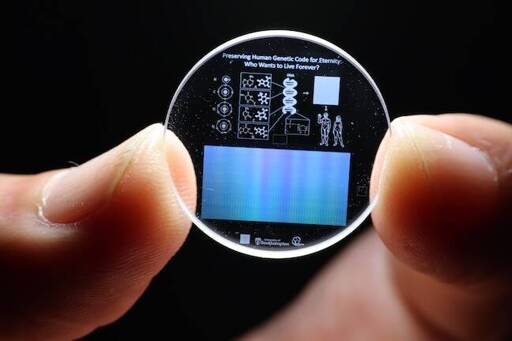
“the medium is silica crystal, similar to optical cable, it’s highly durable. It’s also capacious: The technology can store up to 360 TB of data on a 5-inch glass platter.”
“the medium is silica crystal, similar to optical cable, it’s highly durable. It’s also capacious: The technology can store up to 360 TB of data on a 5-inch glass platter.”
I wonder what the read write speed is. Imagine storing your entire movie collection in a crystal the size of a coaster.
Might not be for home consumers anytime soon, article says: “In the next 18 months, the company hopes to have a field-deployable read device that customers can use to read archived data. But SPhotonix isn’t presently targeting the consumer market. Kazansky estimates that the initial cost of the read device will be about $6,000 and the initial cost of the write device will be about $30,000.”
Then goes on to mention they need about 3-4 years of R&D so they can be ready to license the tech
Manipulating the atoms in a crystal to store info is extremely high-precision, as is verifying the accuracy of the write). So is reading positions down to a few nanometers, But consumers wouldn’t need a $6000 reader to get, say, 10GB dumped to a hard drive … you’d carry your crystal and 16GB drive down to the corner store and user their reader to dump sector 37BJ to the drive. No need to trust them with your platter … but are you exposing all 360TB to potential damage from the machine?
In case you missed it in the article, the transfer speeds are mentioned just two paragraphs prior to the one you cited:
Writing 360 TB at 4 MB/s will take over 1000 days, almost 3 years. Retrieving 360 TB at a rate of 30 MB/s is about 138 days. That capacity to bitrate ratio that is going to be really hard to use in a practical way, and it’ll be critical to get that speed up. Their target of 500 MB/s is still more than 8 days to read or write the data from one storage platter.
One counterpoint - even with a weak speed to capacity ratio it could be very useful to have a lot of storage for incremental backup solutions, where you have a small index to check what needs to be backed up, only need to write new/modified data, and when restoring you only need to read the indexes and the amount you’re actually restoring. This saves time writing the data and lets you keep access to historical versions.
There’s two caveats here, of course, assuming those are not rewritable. One, you need to be able to quickly seek to the latest index, which can’t reliably be at the start, and two, you need a format that works without rewriting any data, possibly with a footer (like tar or zip, forgot which one), which introduces extra complexity (though I foresee a potential trick where the previous index can leave an unallocated block of data to write the address of the next index, to be written later)
I was so blind sided by the fact that the tech isn’t for consumers that I forgot to mention the r/w speeds
If it’s slow, then it’s the central backup and you use anything else for regular use. Just having it as a fallback for recovery would be huge.
I’ll have a crystal collection that’s actually useful
We desperately need a non-magnetic storage for obvious reasons … But making a new thing is freakish difficult.
That’s the joke. The speed of a lot of these tech would require twice the time the data retention to write it.
We can place atoms in order on the head of this pin and store 30 Pb. Write speed? 1KB/min
Did you read the article? 30mbps is faster than a lot of people’s internets. It’s not fast, but for a prototype, it’s not bad.
You need to put the capacity into perspective with the storage speed. The comment I made simply highlighted the issue with an extreme example… For the reasoning provided. And as someone who’s worked with emerging tech before… 30 Mbps is their ideal lap time in a lab environment. Do remember that 100 Mbps is considered absurdly slow for networking. 1Gbps sounds fast but even those transfer rates move into hours and days for larger file transfers.
This is explicitly stated to be for cold storage though. It doesn’t have to be fast at all. And they’re supposedly aiming for 500mbps soon.
They are at 30 presently. The “standard” is somewhere around 300-500 which, again, is acceptable for cold storage at the current tape drive size of 10-30tb.
There are minimums expected as density increases. Cold storage / backup still needs this to be viable.
That’s cheap enough a small business could do long term backups for individuals and other small businesses.
I had the exact same idea, you could upload your data to cloud storage, and have them write it to the doodad and send it to you.
and/or provide them cloud access to their crystal since they may not want to buy a reader