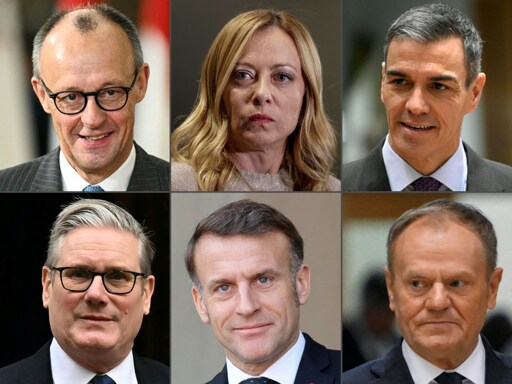
European NATO leaders have issued a joint statement that “Greenland belongs to its people” and it is for the Arctic island and Denmark only to decide on its future, after President Donald Trump’s administration reiterated its wish to take control of it.
The statement said that NATO and its allies had increased its activities and investment to make the Arctic a safe place and that Denmark and Greenland were part of that alliance.
We need to bring Ukraine war to an end ASAP
I’m starting to think trump and putin are working together on this- if they keep Europe occupied and distracted the orange man can sneak in and take Greenland under their noses. I hope we’re in a spot where we can turn things around for the better, but I fear things are about to turn for the worse globally in the next couple years.
The orange felon/rapist doesn’t care a wit about sternly worded letters.
The orange rapist also doesn’t care about someone saying “no”.
If us troops invade Denmark. I will actively root for the murder of us troops by the people of Denmark. As an American, make an example of us
finger twitching over the little foam finger that says “Death to America”
Don’t make me do it, I’m warning you.
It makes me sick to think about the US invading Greenland, and Canada is literally unthinkable. But if you believe for a second the US will be made an example of, I’m sorry but you’re just mistaken. As much vitriole as we might have toward the current leadership, the US is very strong and very capable, and the rest of the world knows that, and I’m not sure anyone wants to bear the cost of going to war with the US. They’ll have to decide if the cost of losing a Greenland, for example, is greater or less than the cost of a potential war with the US. And realistically, it’s less. Which is concerning.
Problem with that is, bullies never stop. Just like Russia, and Hitler before him, you give Trump what he wants when he bullies you and he will just take more.
The cost will be greater. Next he will demand Iceland. Then Portugal. Then pootin attacks Poland. When do you fight back? When no one’s left but you?
Are you quoting Neville Chamberlain?
I’m just some dude on the internet with an opinion, nothing I say matters.
I need to have this on the bottom of each of my posts. Bring back forum signatures.
The same situation didn’t exist then; in fact the parity was in reverse.
In no way was Nazi Germany more powerful to such a degree over Britain and France.
They conquored the entirety of France in a month and a half shortly after “peace in our time”
It won’t be murder. It’ll be self defense of an invading army. And any American soldiers that go along with this highly illegal order will very much deserve it and I hope they die.
This will always lie at the feet of American voters. For failing at more than just this election.
C’mon, bring on the downvoters, pissers and moaners, excuse makers.
I’m not downvoting. You aren’t wrong.
The US election system has been fucked a long time. That’s also true. It disproportionately supports conservatives.
That said, he really did get something like 75 million votes. 75 million trashy people living in the US who are still out there looking at this bullshit and saying “I voted for this.” There is no excuse for that.
The system isn’t great but there is still a way to get the people they need in. The Republicans prove this pretty much every election.
It disproportionally serves conservatives because others didn’t and don’t vote.
It’s been on the voter for a long time. Excuses too; in 2016 and earlier it was ‘our right not to’ now it’s ’we can’t because jobs/timing/whatever’.
That is an oversimplification. The disproportion is literally that: the Electoral College means people in states which have higher populations get lower representation. And higher populations tends to mean bigger cities, which (worldwide) tends to mean more left than right.
The Republicans get the people they need in exactly because of this disproportionality.
Also true that relatively few USians vote – and that’s at least partially related to having no national voting holiday, plus elections on Tuesdays instead of weekends. It is literally in the Republican platform to have fewer people vote. They’ve just been successful at it for a long time.
RE 2016 and earlier, I have not seen that pattern.
The dude is really asking to get got; lives in a country with millions of guns and talks like the SS hasn’t fucked up before.
I really had to pause at the SS part.
The parallels are drawn intentionally.
At this point, his security is no doubt up there with Putin’s. Also, he needs extra guarding on his bad dementia days. Watch him wander off from Japan’s Prime Minister. His mind is gone and he is under near absolute control.
Greenland is a legal property of NATO member Denmark. Experts are saying a forceful annexation or invasion there would collapse the alliance and end NATO. You know, the major thorn in Trump’s handler Vladimir Putin’s side? The check against invading smaller countries, and the alliance he’s been railing against for years…? And the only thing that’s stopping him from increased aggression against other countries near him? This shit’s so obvious and out in the open. There’s no consequences, so they don’t even have to hide it anymore…
So, it doesn’t change your point, but “legal property” isn’t really the right word for an entity that makes up it’s own laws and can ignore the laws of everywhere else. I’d stick with “territory”, because it’s about their local monopoly on the use of force, and mutual recognition by other sovereign powers.
Defending a country’s territorial integrity is not defiant; if anything, the country threatening that integrity is the one acting in a reckless, defiant, and dangerous manner.
Defiant in the face of a would-be oppressor
Yeah that choice of words didn’t sit right with me either.
Hardly defiant.
Strongly worded letter. We know this is not what Trump and his ilk respond to. They’re going to have to find some form of material leverage, if they have any, to strengthen the argument.
That’s not so hard. Ban silicon valley social networks. Put a heavy tax on any digital goods and services with a headquarter in the USA. Trump is very sensitive to those. Then move on to put tariffs on physical goods. Cancel orders of USA military products. That’s a good beginning.
Commented yesterday that America may someday build an Iron Curtain across the Atlantic, but you got me thinking Europe should lead the charge on that.
Expel all Americans, close all embassies, shut down American social media, cut all American imports, do it now. Our Homeland Security Advisor was on TV two nights ago saying, “We’re taking Greenland, it’s ours, nothing anybody is going to do about it.” What more impetus does Europe require to act now?!
Could start there based on the threats alone.
Why aren’t they doing these things already? Because Trump has made a deal with the devil so nobody imposes consequences on him for anything ever
Put some sea mines around its potential landing areas as well. That should work better than words with Trump.
Dress the mines up like teenage girls.
An attack on one of us is an attack on us all.
Regardless of the outcome for us Europeans, good or bad, the USA invading a NATO nation will mean war. Hopefully a phoney war that’s resolved quickly, but regardless, war. Period.
The question is, are they willing to burn every single alliance and friendship they have, and start a literal third world war, just to annex Greenland?
And for what reason? If they wanted more military presence there (they already have some, don’t forget) they could just ask, Denmark is their friend and ally (not that the USA remembers this or cares about alliances any more), and would be open to discussing the details and sorting things out.
It seems like the actions of a deranged madman, not the calculated moves of an intelligent, purposeful world power.
I have a feeling that EU contries would act with as much resolve as was done with Ukraine. So if Greenlanders can’t fight by themselves for a couple years, other EU nations will have no one to donate helmets to.
They would also be more hesitant to make Trump mad than they were ever afraid of upseting Putin.
No one has an apetite for war. Even when it is necessary for your future security. Only dictators are fine with war.
Greenlanders can’t fight the US. They number less than 60,000 souls, a third of those in a single city. Of those willing and able to fight, they’re armed with shotguns and hunting rifles. Worst of all, you can’t fight a guerilla war in the Artic, even deserts are more human friendly. They’d have to magically transform into snow Freman to keep up a fight.
The EU’s choice to stand back on the Ukraine war is exactly what will embolden Trump’s handlers to take Greenland.
The EU can barely fight the US. Do they want to get into a costly war with the US over Greenland? That’s it. That’s literally the only way the heads of government think, in dollar signs. Is the cost of going to war with the US worth more or less than Greenland.
Russia, the US, and China are all making their moves to define the world for the coming century. World War 2 ended 80+ years ago. It’s unfortunately natural for humans to want to fuck shit up again.
You can’t make a comparison to Ukraine and the Russian invasion. Ukraine isn’t a NATO member nation, whereas Denmark is.
I’ve made 100 comments, but here’s another:
As global warming advances, Greenland becomes prime real estate. Prospecting and mining will become easy and practical and year-round Artic shipping lanes will open. Not to mention it’s a great place from which to project naval and air power.
Suprised to see Meloni along them
Why? I know she was agreeing more with Trump than anyone should, but her nationalism definitely wins over potential soft power
Far right “nationalists” tend to sell their countries to the lowest bidder for personal gains, so yes, it’s surprising
nationalism
greenland is not part of italy
Her country is still at risk.
If you are surprised to see anyone there it sound like you haven’t realized yet that they are all corrupted and do whatever benefits their interests.
That’s probably exactly why they didn’t expect to see them
More surprised at starmer being there honestly
I’ll believe they mean it when the US military base in Greenland is evicted.
That’s what he wants. He’ll claim that as a provocation and use it to expand the US military coverage in the area. His MO is to do abhorrent things until someone snaps, and then point at that someone and claim they caused it. And something like 70 million morons in the US completely buy it and have the memory span of goldfish.
The alternative is do nothing and you get the Venezuela treatment anyway.
Came across this clear reason why the child rapist has set his eyes on Greenland and no media is talking about: He wants Greenlands precious metal since they designed their gate keeping primary military spearhead (F35) with one little flaw: it needs a rare metal only widely available in China… https://youtu.be/ng4cwPNIag0
Bingo! And I’ve commented many times that global warming makes mining and prospecting easier, and year-round Artic shipping lanes will soon be a thing.
Costs so sunk that you need to invade a sovereign nation
Warfronts on YouTube has also mentioned this in a few of their videos that cover the topic as well, although I’ve not heard it mentioned on any large media platforms.
A joint statement is great, but it’s still words. I fear Trump and Putin aren’t taking the EU very seriously because we’re mostly words.
These words would carry a lot more weight if people believed Europe would back them up. And the most obvious way to do that, would be to liberate Ukraine. A Europe that liberated Ukraine from Russian occupation is more easy to believe when they say they will defend Greenland as well.
The issue here is to dissuade the US and Russia from even trying.
Well moving EU troops into Ukraine would rapidly cause Russia to go to war with the EU, and in short order, US would be forced to make a decision as part of NATO.
Unfortunately I suspect the US would use the moment to backstab the EU, abandon them, and attack Canada, Greenland and Mexico, since no one could come to their defense.
We need an alliance with China.
Russia is struggling with Ukraine. They cannot deal with the EU. Even without the US.
Biggest problem here is that the US may actually just try back out of NATO (in action rather than treaty) and basically abandon Ukraine and straight up back Russia.
Though with Venezuela and now the threats on Greenland, it will be hard for us (the US) to claim that we have no appetite for war. Which has been the biggest excuse to ignore our allies.
More specifically, Russia can’t deal with a united EU. They might be able to deal with us one at a time, and we have a tendency to be divided. If there was ever a time we need to set aside our differences and recognise that we need to act together and decisively, it is now.
And we need to wrap up Putin’s crappy war in a way that keeps Ukraine strong and on our side, so we will be stronger, and we can be prepared to deal with the US if Trump goes for Greenland.
Did you read the US national security policy they just released? Have you been listening to everyone over the last few days? They make it very clear they intend to secure the Western hemisphere because they think it belongs to them. Your country thinks my country belongs to you. Trump is very likely going to move on Greenland, and once the pretense is gone I imagine he would do exactly what he claims to want to do, in formal policies and all over the media.
I don’t know why Americans seem to think “oh he’s just joking this time”. A rule of thumb: If it involves making people’s lives worse, he’s not joking. He wants to control the Western hemisphere and if he has to kill millions to do it, he will.
You’re in denial if you don’t think Trump is going to drive the world to war. Or maybe you happen to believe that my country does in fact belong to the US?
I agree with every bit of that except ascribing these actions to Trump’s wants and vision. He would be perfectly happy getting fatter, holding rallies and grifting from the Oval Office. These actions are put into his head by handlers such as Miller, who’s the most visible.
Trump is the perfect tool, a malignant narcissist fallen to dementia. He’s easier to control than a toddler. All they have to do is keep him off camera on his bad days and let him have his way with meaningless stuff like renaming the Kennedy Center.
tl;dr: Trump is in control of very little. While we point fingers at him, the real powers behind the throne are moving fast and mostly undercover.
I’m American and I didn’t think he was joking during his first term and this term I fully expect that in a month the US will take Greenland, I don’t know anyone who thinks Trump is just a Lil goofy guy making goofy jokes.
No prediction on when the US takes Greenland, but it’s happening as soon as the administration feels they have Venezuela under control. They’re not repeating Hitler’s mistake of not driving for the Russian oil fields before opening more fronts.
Removed by mod
Not all. We’re not going to station a hundred thousand troops on Greenland. That war is going to be fought mostly at sea and in the air, with relatively small numbers of arctic units on the ground.
The main thing we need is subs to sink the aircraft carrier they will send. The US is about as far from Greenland as the UK, while Canada and Iceland, both NATO, are closer. That gives us the advantage of closer airfields and fjords to hide subs. Once the US loses a carrier group to Trump’s folly, they’ll reconsider the wisdom of their greedy aggression. Maybe not Trump and Miller, but everybody else will.
I don’t think we should engage with their carrier in the air. Our air forces are first needed in Ukraine to provide air cover for a breakthrough there. I know it sounds utterly nuts, but I think NATO has a fair chance of fending off Russia and the US at the same time. But we need to be more decisive than we generally are.
Removed by mod