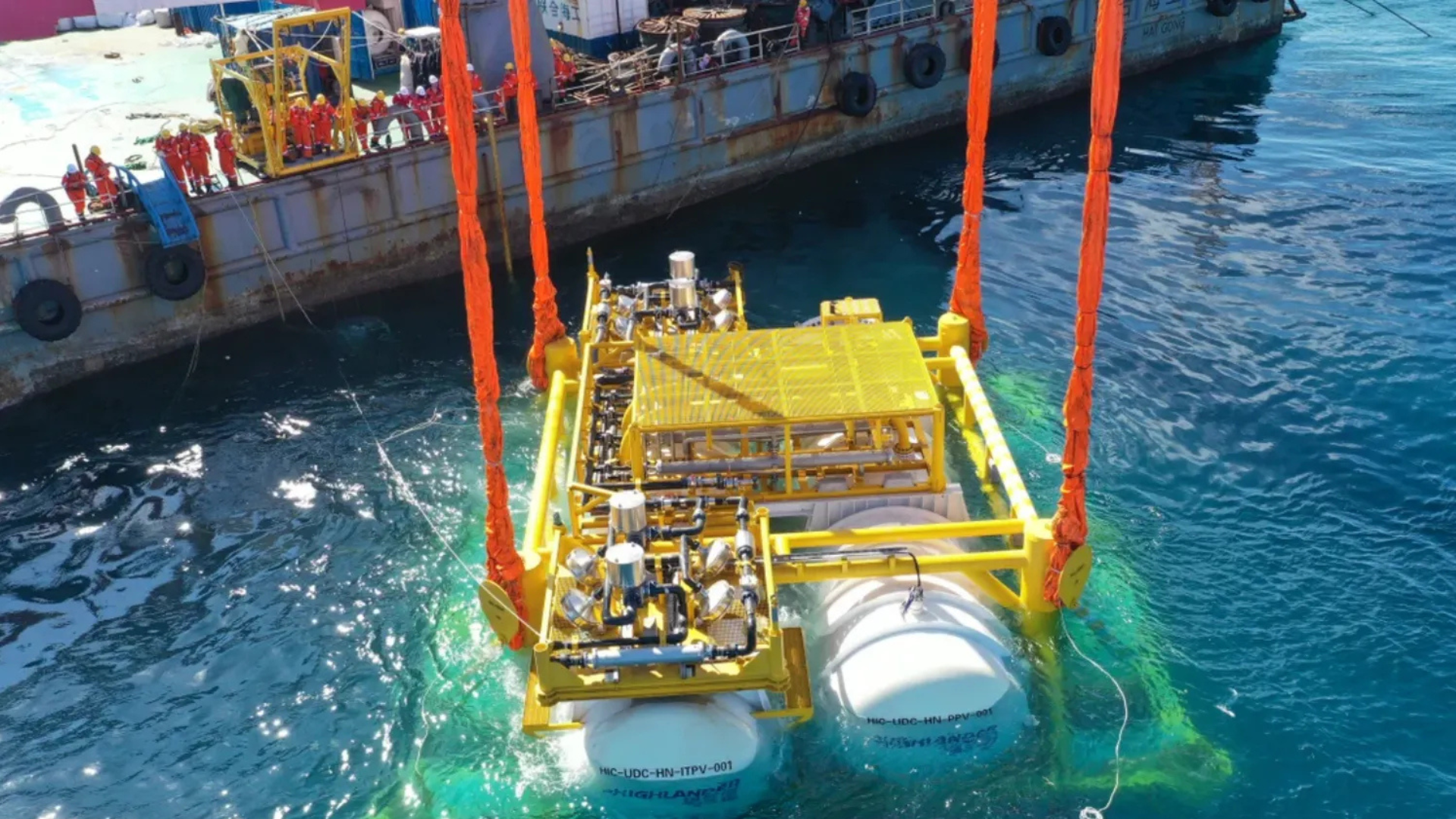
sudo systemctl poweroffOH FUCK I was in an ssh session!
*Puts on scuba gearDeep sea
welderadmin.Most stressful job imaginable
At least you won’t have to deal with end-users on site.
Hopefully that server has IPMI.
I’d really like to know how they handle all the small-scale HW issues. As a DC tech, I’m kept quite busy with those
There was an Intel experiment a while back where they left a bunch of racks in the parking lot. They found that the failure rate wasn’t much higher than inside, and not needing a data center building saved money. Maybe this project just accepts the eventual failure of components.
Sure, if there is zero weather a building wouldn’t be needed.
Computers can’t get wet from the rain if they’re underwater in the ocean.
👉😏
They did get rained on. I am having trouble finding an article about it now.
I bet they duplicate everything and just switch off faulty units. Every year or so, they would emerge the whole thing and replace what they need at a large scale.
Sounds expensive. I’m betting they just abandon it and sink a new one with new, faster hardware.
I’m thinking they replace the module every so often when it fails
Probably have diver it techs… boy that’s kind of cool
Larger DCs don’t replace individual components, they wait until a percentage of servers on a rack have failed, then replace the rack or servers.
They will likely adopt this same model
They’re probably stacks of 8x NPU Huawei servers all cooperatively serving the same few models.
As an older example, I believe Deepseek V3 was most optimally served with ~384 GPUs in a single cluster, before they switched to Chinese NPUs. So they’d have some software that ties all these together as one “server” and maybe multiple of those all serving API requests for one endpoint.
But it doesn’t actually need all 384 in each server. Many models will fit in a single 8-GPU/NPU server, but the software pools more just to try and utilize the hardware better.
If one server fails, the system would return a few requests as empty and have to restart the serving software, but… that’s fine. All the data is ephemeral. Even if the whole 24MW unit fails, they can just route API requests somewhere else, and a few failed generations isn’t a big deal.
Let’s boil the ocean everyone.
I wonder how many sq km of data centers it would take to increase the temp of the ocean by 1 degree.
This page says the ocean is about 352,670,000,000,000,000,000 gallons, which is about 1.3 x 10^21 liters, and each liter is a kg of water (yeah, yeah, the dissolved salt adds some mass but I don’t think it adds sufficient thermal mass to make a difference). It takes 4.184 kilojoules to raise 1kg of liquid water 1°C, and 1 joule is 2.778 x 10^-4 wh.
So that’s 1.55 x 10^18 watt hours, or 1,550,000 TWh.
Global electricity consumption is about 30,000 TWh per year, so if you use the entire world’s electricity consumption for 51 years you’d raise the oceans’ temperature by 1°C.
Or if you take global data center power capacity of about 125 GW, and ran them at full power 24/7, you’d be producing about 10.8 TWh per day or 3944 TWh per year. It’d take about 393 years of the world’s data centers to raise the ocean by 1°C.
Just goes to show that much more of the energy heating up our world and our oceans is coming from the sun heating up the planet and the planet failing to radiate it out past our greenhouse blanket, not from the actual heating of our atmosphere from our own energy sources.
So if data centers continue to be built then we’re pretty much lining up another climate apocalypse behind the one we’re currently in.
This really is some great filter shit.

We… We’re already doing that.
Sorry. :/
I didn’t know you’d find out this way.
Instead of drilling into the core we’re just going to get boiled alive. Pretty poetic for a garbage system like capalitism.
But … It’s China. It’s not jst capitalism, it’s human greed and fear.
It’s just capitalism.
The only difference is that their capitalism is controlled by the state instead of an international oligarchy of billionaires.
This makes me wonder what is better - underwater DCs heating the oceans, or above water ones with all the pollution creating and water sucking cooling instead. Part of me thinks the underwater one might be better.
The issue with climate change was never with “heat production”. It’s always been the generation of heat trapping chemicals. The sun sends a stupid amount of energy our way. Generally the earth radiates almost the same amount back out into space, with a minor amount captured by various things, like photosynthesis.
Pollution alters that equation and causes more energy from the sun to get trapped in the atmosphere. That’s the problem. We could never generate as much energy as the sun (even the tiny amount that hits the earth), but we can definitely alter the atmosphere to trap more and more of that heat.
Also, the ocean is a MASSIVE heat sink. I saw someone work out the calculations recently, I don’t remember the numbers, but the conclusion was that we’d never measure a notable increase in ocean temps if we housed every datacentre in existence in the ocean. The sun hitting the ocean every day dumps more energy into the ocean directly than we’d ever be able to manage.
It all comes down to pollution.
If you take local temperatures of the ocean at different latitudes, they won’t all be the mean temperature of the ocean. It isn’t a single massive heat sink.
Data centers raise nearby temperatures by up to 4 degrees in Phoenix
But that’s true no matter where you put the data center. If you have to dump the waste heat somewhere, the high density and specific heat of water is a better heatsink than the air around us.
It’s also likely to impact more living things (plankton, seaweed, fish, reefs) in the same space, given the locations likely to be considered, either due to biodensity or increased heat spread because of high water conductivity.
I think you have to look at the actual orders of magnitude difference in raising the temperature of water versus air. The Arizona story you linked is about a study that found up to +4°F (+2.2°C) temperatures in air.
The same amount of heat, spread across the same volume of water moving at the same speeds, would only raise that water by
1/830 as much, for a +0.0048°F (+0.0027°C)1/3300 as much, for a +0.0012°F/+0.00067°C temperature change across the same area/volume.(I got to 830 by taking the specific heat of dry air of approx 1 J/g K at room temperature and regular atmospheric pressure and 1.22 kg/m^3, versus water’s 4.184 J/g K and 1000 kg/m^3).(Edit: I fucked my math. Water has approximately 3300 times the heat capacity as air, per unit volume, and I just looked it up directly).
The higher conductivity of water might be offset by the higher convection potential of air (because air responds to temperature changes with differences in density/pressure, which creates wind in itself), so that the heat will spread through either medium relatively quickly and therefore dissipate very quickly with distance to the source.
I just don’t see a world where a data center raises the water by even 1°C, even locally.
I don’t believe they meant it that way. At that scale, literally nothing will be a uniform temperature.
That’s true, but water is so much more effective at absorbing heat than air, the effect will be negligible. It takes about 4.2 megajoules to raise one cubic meter of water 1 degree C. That energy would raise over 3 cubic KILOMETERS of air 1 degree C.
Even putting data centers at the bottom of large lakes would be unlikely to have an effect. It will not be percetable in the ocean. Regarding temperature anyway, other factors are worth considering.
The total effect is negligible, but even with high conductivity, local impact could be destructive enough. Even with an infinitely large copper pan, I wouldn’t put my hand on the part that’s on a stove’s burner.
That’s true too, but the impact will be very very local. Really, we just need to have fewer data centers, but at least by putting them in the ocean we are only impactfully warming probably less than 300 cubic meters of water instead of an entire neighborhood, or depleting groundwater to cool the damn things. Seems like the least harmful way to cool them, if we’re going to have them.
Yeah, fully agree.
Parts of the ocean are colder and several species are having issues locating new spawning grounds.
I remember hearing of a corodile species or something that recovered due to a new power plant discharging warm water.
Overall ocean temps rising is a problem, but the real problem is becoming more uniform temps.
Cold spots are getting warmer. But warm spots are getting colder too. And especially for fish and reptiles. They need warm spots to spawn.
Ecologically speaking this is likely to be a good thing and within a couple years this could be a very important habitat that people are talking about and acting shocked about.
Even tho logically it’s obvious
Hahaha. Yes we’ll just temp control the ocean and this the planet. Mother nature you’ve been replaced.
Buddy…
Heat rises, that’s how a hot air balloon works.
You put something hot at the bottom of the ocean, as it heats the water, that water rises.
Cold water comes in from the sides, and the process repeats.
A geothermal vent does way more than a data center does and is a huge ecological benefit.
Obviously there’s better things to put down there then a data center, but this is literally the only place a data center is t hurting the planet simply by existing.
Hell, build near an existing vent and harvest it’s heat for energy why piggybacking on the existing currents and you can literally get “free” compute power with no ecological downside.
This tech won’t end with this data enter, it’s just where the money is currently at and that drives our research these days.
…
Like, it would probably take a lot more typing for people to get how huge this is, but we’ll be lucky if we’re still alive to see the real benefits of what was developed for this project
Buddy. Putting a random artificial heater in the ocean once isn’t going to be a problem. It is when companies put 100+ there. Also., just because nature has something you can compare this to doesn’t make it anywhere near an analogue.
Wouldn’t maintenance be a lot easier if they just placed it near the sea and pumped the water through from there? Or used a heat exchanger. All water going in is sent back out at a higher temperature.
By placing the heat sinks directly into the water there’s no electricity needed for a pump, and tides, weather, and heat convection will move the water around.
Having the entire facility underwater also means less exposure to the elements.
Saltwater is one of the harshest terrestrial environments for a data center other than maybe lava. Pressure, oxygen, and sodium ions make the ocean extremely corrosive to metal structures.
You could be right about the first part, but I take issue with the second. Ships in seawater usually need sacrificial anodes so corrosion eats those instead of the hull and fasteners. I’m not sure how that would affect heat exchange, maintenance, or long-term reliability. It would definitely limit the materials you could use.
You know that those sacrificial anodes are simply zinc, right? One of the most plentiful metals on the planet?
Why would anyone on earth not make those simply swappable, like on boat motors, and on ocean going vessels.
We have been building ocean going vessels out of metal for over a century now. I think those so-called engineering challenges are solved.
Ever notice that the vast majority of oxidation actually occurs ABOVE the waterline?
Care to guess why?
Here’s a hint, look at the first 3 letters of the word “oxidation.”
Edit to add: Plus there’s different metal choices for the actual heat exchangers, such as stainless 2507 or even titanium, which is extremely resistant to such corrosion, and for the parts of the building that do not need heat exchange, an insulating coating will mitigate nearly all oxidation issues.
You clearly know more about this than I do. I understand the anodes are zinc, but you have to use materials that are going to feed on the zinc rather than visa versa. I honestly don’t know if that’s a meaningful limitation or not. I just know about boats and how to delay the water from destroying the hull.
First off, there’s no need to be that combative. Second,
Here’s a hint, look at the first 3 letters of the word “oxidation.”
There’s plenty of oxygen dissolved in water.
Combative?
You’re reading way too much into words without emotion.
They’re words.
And while there’s oxygen dissolved in water, it’s still less likely to cause oxidation than the oxygen in air.
There’s study after study on this, and you would do well to look those up.
What maintenance?
If the server is in the same room with you, you don’t need to over build. If it’s at the bottom of the ocean, you build it not just with redundant internals, you package reduncancies in full moduales.
If module 1 has a problem, switch to back up, and swap module 1 for a new full module.
They’re not opening shit up and exposing it to sea water, everything will be in water proof containers, and you just hook up a couple connectors.
The only “maintenance” underwater will be unplugging something to raise it and connecting the replacement you sank.
As far as heat exchange, it happens all around it. Not just natural circulation, hot water rises and cold water sinks.
Even in a lake with no currents, if it’s deep enough that produces flow on its own.
How many AI datacenters will it take to boil the ocean?
Around (4 to 6) * 10^(26 to 27) J total
1 gigawatt is 10^9 J/s (so around 130 billion years to reach the above.) For a terawatt that’s 130 million years. For a petawatt 130,000 years. For an exawatt about 130 years…
Note: the sun bathes Earth with around 170,000 TW (0.17 exawatts) of energy. That’s about 700-800 years if you could make the oceans sink all that sun energy. Again, this isn’t the total output of the Sun but just what impacts Earth directly.
40…2…ob…viously…
If it’s being powered by wind, it’s not adding additional energy to the environment, at all. It all comes down to conservation of energy, and no chemical changes are occurring.
Electrical energy is being generated by harvesting kinetic energy in the wind, that’s essentially just moving energy, converting it from one form to another. Energy can be swapped and converted around, but in the end, it almost always ends up turning into heat or light.
That wind, one way or another was going to convert its energy into heat. Most often it does that by convection, causing water vapor in the air to change state, after condensing, the now warmer water release its heat into the ocean when it falls as rain.
Turning a wind turbine to generate electricity, to run computers, is a much more elaborate route to take, but the result is the same. The wind is moving slower, a lower energy state, but the ocean is warmer, a higher energy state. It all evens out.
Edit: I just realized, that sometimes that kinetic energy from wind contributes to storms and sometimes those storms generate lightning, and while most of the energy from lightning does turn into heat, some of that energy generates light, and some of that light shoots out into space (actually escaping the earth). So probably, higher wind speeds do result in cooling the earth a very little bit (but it’s likely negligible)
Well part of the wind also comes from the solar activity warming parts of the earth up and thus changing the pressures around so it’s not an entirely closed system
Well, if the energy comes from solar on the thingy, then it’s probably going to cool the ocean, could be similar with wind.
That’s a good point. Maybe not cool, but it would warm the water less.
(I’m guessing solar cells reflect less energy back into space than water, since they’re specifically designed not to.)I don’t know how to objectively figure this out, but solar panels only convert energy from radiation down to far infrared of 1100nm. Water can absorb longer wavelengths, but solar output has less and less energy output at these wavelengths. However, the mystery is whether or not the panels themselves absorb or reflect such far infrared energy. I’m torn between “it might be the same” and “I’m wrong”
It would probably take more energy than we can harvest on earth, considering the sunlight and geothermal energy doesn’t boil it currently.
I could see it affecting the temperature on local scales, such as the area immediately around the data center.
I don’t think people mean literally boil the ocean. Just increasing it by few Celsius degrees can be world ending.
That’s true, but I still don’t think we can raise ocean temperatures through direct cooling and renewable sources the way that the greenhouse effect can. Water can absorb a lot of heat energy without changing temperature, and that is why regions close to oceans have a more temperate climate.
While I don’t have enough knowledge in this field to be making any definitive statements, my logic is as follows:
- outside of nuclear fission/fusion reactions, heat energy on the earth’s surface comes from either the sun or molten rock in the core
- that energy is responsible for everything that happens on earth, including wind energy
So we would need to get energy from off planet, use nuclear fission/fusion, or cover enough of the land area in wind and solar farms in order to redirect the sun’s energy over to the oceans.
I think the bigger concern, when it comes to heating the ocean, is that manufacturing, construction, and transport related to the data centers still releases a lot of greenhouse gases. Those gases trap the sun’s energy within our atmosphere and that WILL heat up the earth. Way more than direct cooling using ocean water.
Burning Oil, coal and natural gas generates heat energy and is generally out of the energy loop trapped in the earth before extraction…
I’m a scuba diver and you can definitely harm regions of ocean with water pumps. It’s already happening in place where nuclear is being cooled. It’s already happening in ship yards.
It’s hard to speculate how it would happen at scale though because ocean science is real fucking hard and each location is vastly different. In populated places the damage would be very noticeable if not eventually catastrophic as ocean issues compound real fast as the ecosystem is much more fluid.
That being said I imagine there would be ways to deploy this safely (ocean is big, lots of boring dead space) but I dont have trust in us to find this way.
If every data centre was passively cooled in the ocean it wouldn’t change temps by even 0.01 degrees. The Sun blasts an entire half of the planet with an absurd amount of energy every day. Energy, which technically originated from the sun, is just converted and being utilized to do work.
There are a number of 6-8GWe nuclear plants that dump 15+GW into the nearby sea (or in the case of Bruce, into Lake Huron). I don’t see it being much of an issue. Better than virtually any other cooling option.
The issues are maintenance, energy source, and equipment supply.
The plants on the lakes so monitor the water temp so they don’t affect the ecosystem during the warmer seasons still.
But I doubt the one in NB had to worry about that when more water flows by it than all the rivers in the world combined.
But yes, much better source of cooling at the cost of maintenance and equipment. Just like tidal power but with fewer moving parts.
The plants on the lakes so monitor the water temp so they don’t affect the ecosystem during the warmer seasons still.
Yeah, but look at the magnitudes of the heat units involved. Modern nuclear plants generate 0.6-4.5 GW at around 30% thermal efficiency (so they generate between 2-15GW of heat). These underwater data centers are looking at 25 MW (0.025 GW) while surrounded by water in 5 of the 6 3-dimensional directions.
There is some risk to local ecosystems, but we’re literally talking 2 or more orders of magnitude difference compared to nuclear plants or other thermal plants.
Good point, although on the local scale you mention, wildlife could still be impacted. Hopefully, the overall impact on the ecosystem will be monitored and studied before expanding these data centers more broadly.
It’s amazing what can be accomplished with financial motivation
This is pretty impressive. If only China had a good human rights record. But then again there’s only a few countries that do and none of them are superpowers.
So there’s a non-zero chance we will find out later that it’s just a bathysphere full of children doing math.
To be fair, there’s a huge difference between some countries human rights records and China. China is IMO easily a bottom 25%.
But then again there’s only a few countries that do and none of them are superpowers.
Really? Which ones?
Personally I’m a big fan of Antarctica.
Never seen their people or government do stupid shit.
Wakanda and Narnia.
So when do we start putting big ice cubes in the ocean?
(Really this at least makes more sense then land slop centers, still silly)
they might move them to antartica or the artic.
I wonder how cost effective this will be in the long run considering how much they’ll have to deal with corrosion. I imagine the maintenance will become pretty overwhelming in a year or two.
Kinda like that dam they keep having to increase the cost of every year.
Microsoft has been experimenting with underwater DCs for close to ten years now…
I don’t think corrosion is much of an issue as it’s water tight.
China: “We will use the oceans water”. usa: “We will use the citizens drinking water”.
Oh don’t worry. Chinese citizens already can’t drink their water.
That’s from the 90’s, the more modern study shows a pretty big but gradual improvement
https://www.sciencedirect.com/science/article/abs/pii/S0048969720374544
If only the US had a coastline.
China will use the drinking water, tell everyone they’re using the oceans water, and then arrest anyone who tries to report on their crimes.
Hasnt microsoft been doing offshore datacenters for nearly 15 years? The one off the shore of the UK was almost certainly majority wind powered.
They built the whole thing? Did nobody warn them there’s no wind underwater?
Tides are the wind of the water
Time to invest in teabag stock.
Still, FUCK AI.
Don’t you see? This is what we needed, a way for AI to fuck over fish too.
Great, let’s boil the ocean faster.