Dumping heat in space is actually hard to do. You’d need huge radiators for radiative emission cooling.
The real issue with space-based data centers isn’t just whether they’re a “bad idea” from an engineering perspective; it’s that they represent the ultimate transition toward a vertically integrated, unregulated monopoly. While everyone is focused on the technical hurdles, we need to look at who actually benefits from this shift. For someone like Elon Musk, this isn’t just a project—it’s a way to own the entire global internet stack. Because he owns the “truck” (SpaceX) and the “road” (Starlink), he can launch and link these data centers essentially for free. This creates a market that is so tightly locked into one ecosystem that it can never be challenged by a terrestrial competitor.
From a purely operational standpoint, space turns every earthly liability into a superpower. Data centers on the ground are a nightmare of land taxes, massive water consumption for cooling, and constant strain on local power grids. In orbit, those costs vanish. Heat is radiated into the vacuum for free, and solar power is available 24/7 without weather or night cycles getting in the way. Even the physical security is inherently top-notch because the hardware is literally unreachable. When you combine that with a mesh network like Starlink, the need for laying fiber lines disappears entirely. The user just needs an antenna, and the “gatekeeper” handles everything else in the sky.
The terrifying downside is that this creates a jurisdictional black hole. If a server is orbiting 500km above the Earth, whose laws actually apply to the data stored on it? We’re talking about a “gated community” where the ownership, pricing, surveillance policies, and privacy standards are all controlled by a single entity with zero competition or government oversight.
Once we stop building ground infrastructure and rely solely on the “space cloud,” we lose all leverage. It’s an engineering miracle for the person who owns it, but it’s a democratic nightmare for the rest of us. It’s not just a bad idea; it’s the construction of a digital kingdom that sits physically and legally beyond our reach.
Heat is radiated into the vacuum for free
When you combine that with a mesh network like Starlink, the need for laying fiber lines disappears entirely
Citation needed.
And on water usage, I will point out that gas generators and evaporative cooling are only used on Earth because other methods (geothermal, big radiators, heatpumps) are somewhat more expensive… Not, like, orders of magnitude more expensive like pure radiative cooling in space.
We already radiate heat away just fine in space, it’s just a matter of how much space do you need to use to do it and all the implications of what that would mean for any given satellite. I wouldn’t call it free, because you need the hardware to do it and the extra weight reduces the payload capacity of whatever you’re sending up, but we can do it.
Starlink also uses laser links to talk to each other which these satellites would also use. How they work can depend, but generally they bounce around in space until they can’t, and they might come back down to land, to move somewhere else over fiber to another ground station until they can go back up to reach you. But the more laser links the less they have to come down for technical reason, but they might still come down for bandwidth reason. I don’t really know how likely it is that any given connection is point to point.
Example of what could happen.
Your dish -> starlink -> starlink -> ground station -> Google -> ground station -> starlink -> ground station -> starlink -> groundstation -> starlink -> starlink -> your dish.
Fiber is still the better option on land if you can get it there, but there are a lot of places it’s never going to get laid, and will never be in the air, or on bodies of water.
Edit: Corrections on the laser links with an example.
On radiators, plugging it into this formula:
https://projectrho.com/public_html/rocket/heatrad.php
I get a circular radiator at least a kilometer wide, assuming the radiator is quite efficient, a rather modest datacenter, and very hot coolant (70C).
…Realistically, the coolant temperature would need to be much lower. See how it’s a power of four in the formula? That means the radiator area gets very large real quick.
I cannot emphasize how expensive a functional 1km+ radiator would be in space. It’s mind bogglingly expensive.
If a space datacenter is in LEO like Starlink, then it’s in Earth’s shadow a lot of the time, and would have to be “part” of the starlink network constantly zooming over the ground. If it’s geosynchronous, then laser communication (or any communication) gets real tricky, and latency is limited by the speed of light. I’m not saying it’s impossible, but reliable high data rates would be an expensive engineering challenge.
For 100kW? I’m not going to try and figure things out from that massive site. A pre made calculator would have been nice if they had one.
edit: It is going to be LEO and likely connected to starlink with the same laser link they use.
Edit: Looking at orbits they might use sun synchronous orbits? It might not be in sun 100% of the time, but they are nearly always in sun.
Edit: I have no way to know if this is right, but a couple AI responses are saying for 100kW it would be ~150-170 square meters with temperatures around 70c
100kW? Nvidia BGX 200 servers are 14kW each, not counting the interconnect, or anything else. According to nuggets I’ve read online, we’re talking 200 megawatts for an Earth-based AI datacenter these days, without something exotic like underclocked Cerebras WSEs (which would be pretty neat, actually…)
Plugging 200 megawatts into this:
https://www.calctool.org/quantum-mechanics/stefan-boltzmann-law
I get about 0.46 square kilometers, depending on the coolant temperature and ultimate efficiency of the system.
I have no clue what the construction of such a monstrosity would look like, but if it was a simple 0.5 inch aluminum sheet, it would weigh like 15,000 metric tons. Even much thinner, that’s still on the order of “mass of a cargo ship”
They aren’t making a datacenter like on earth. They’re putting up a ton of satellites that will each generate about 100kW.
Everyone keeps thinking they’re putting these massive things up there, they are not doing that.
Edit: Oh I missed your tool this time was a real calculator this time, thank you! That says 127 square meters, with black body, 70c and 1 (but no idea if those are good values)
That’s interesting, but what’s the point? If it’s like 2 DGX boxes in each satellite, spaced out, the interconnect between them is going to be very slow, and the individual computational power of each satellite will not be that impressive.
And if you connect them all in one constructed mesh and wire them together, well, you’ve made a 200MW datacenter! The economies remain the same.
If hardware gets more power efficient, well… Then why do you need to go to space anymore?
Heat is radiated into the vacuum for free,
Is it though?
Granted I never made it further than freshman level physics in college but doesn’t heat needs a media to radiate away. Otherwise it just stays in place? So there would be nothing to move the heat away from installation? The ISS uses these big radiators the emit the waste heat as infrared light. That seems like a plausible method to exhaust waste heat. But I don’t have any clue if that can scale up to the level of a huge data center compared to the systems on the ISS
Heat is energy as “vibration of molecules”. It spreads to adjacent molecules by conduction, unless we have other interesting things going on. Easy stuff.
Vacuum is the absence of molecules to conduct heat to.
Wait…
Well, it can also radiate away in the form of EM radiation, typically infrared. That takes time though.
Yes, ISS radiates heat to space. The total ISS power burden and by extension heat dissipation need is less than a lot of these GPU racks. They need big radiators just for that. Imagine ISS sized radiators per rack of equipment, how for apart the equipment would have to be, how much more mass cost for launch that is, etc etc…
Thoughts?
These are my thoughts https://distantprovince.by/posts/its-rude-to-show-ai-output-to-people/
Your thoughts were really well written. I’m glad you took the time to explain your viewpoints organically instead of taking an easy way out to avoid having to do it yourself.
How about this for what my post was trying to say…
It’s a good idea to the person who can pull it off. It will be highly profitable and they will monopolize that ecosystem. For the rest of us, if this were ever to become adopted wide spread, it has the potential to make something that normal people can no longer compete with and can’t easily avoid (assuming it is significantly subsidized initially to offset cost and get users to adopt it)
Pardon my potential ignorance, but I’m under the assumption that radiating heat in vacuum is NOT easy. Normally, heat escapes from sources into the surrounding atmosphere, whereas in space, only radiant heat (IR?) can bleed off into vacuum. The conductive heat from, say, a cycling loop of water still needs a radiator that vents into surrounding volume. Without atmosphere, radiators can’t conduct efficiently, right?
Please set me straight if possible.
I’m no expert, but this is my understanding as well.
My question is always how the hell are you going to cool them. Do you know hard it is to move heat in a vacuum?
A radiator. Next question?
What’s going to be performing convection to dissipate heat from the radiator in a manner to support the heat generated by an AI data center?
What part of radiator don’t you understand?
Tell me you don’t know how radiators actually work without telling me. They dissipate heat via convection through the air surrounding them or gasses in general. What does space lack a significant amount of?
Yeah so there is some confusion here. The are radiators on cars or in houses, but those are more accurately heat exchangers. Then there are things like heat lamps, which are really IR radiators that convert electricity to infrared light that feels hot.
Most of the heat you feel at a camp fire is radiant from the flame, unless you are down wind and feeling some convective heat, but most of that heat goes straight up with the smoke.
There’s a difference certainly but do you think the people who seem to be floating this idea know the difference?
Hard to say, but they’ve been using
resistiveradiative cooling In space a long time.Also a tech ingredients made a neat video about building one and radiating heat out into space from the ground. It was cool to see what happened when it was cloudy and stopped working.
Radiators dissipate heat through…wait for it…radiation.
Do you know how BIG they would have to be to dissipate a data center worth of heat to keep it as cool as on earth?
Do you?
Do you know how much heat they would need to retain?
Right… and a carpet is a pet you keep in your car, got it.
What you don’t understand is the size requirements those radiators would need to have to cool an entire data center.
It’s conserved.
Right. Exactly zero understanding on your part.
Zero effort shit post. Cool.
Do you ever make posts that demonstrate what your opinions are or what your own thoughts are or do you just like to talk about other people and put them down cuz it makes you feel better?
Obnoxious as he seems to be, he’s actually right, there will be no convection, but they’d radiate heat in a vacuum, by IR IIRC.
You’d need an enormous radiator to move the heat a data center puts out. Not even all the billionaires put together could afford that.
Sure, the idea is as bad as solar roadways. It’s actually kind of impressive to come up with an idea that bad.
To do that they’d have to be filled with something other than something water based to be able to do that over a large area which would require constant maintenance to do so. It’s not easily feasible and I doubt people who want to do this or defend it realize that. I have to look it up but it takes Anhydrous Ammonia to perform that in the ISS. Like this is a bad idea and it fries my brain people trying to defend this.
Easy, just create a long heat sink and dangle it in the earth’s atmosphere. Now we are winning!
From that to a space elevator…
Have you never seen a movie set in space? Evrytime someone gets sucked into space they freeze. You saying every movie got it wrong?? Space is cold. Duh.
Please tell me you aren’t serious.
dude! how do you expect anyone to answer if you don’t say surely you can’t be?
I am serious, and don’t call me dude!
Dude stop
They are completely cereal!
Super cereal
With radiators just like with every existing satellite system.
https://youtu.be/DCto6UkBJoI&t=12m57s
Very large scale datacenters would likely have some nasty fluid handling problems to solve.
I’ll just note that I am not a fan of putting internet infrastructure in space. I think polluting the upper atmosphere with a bunch of metals every time a satellite deorbits will certainly have negative consequences. So IMO space should be limited to things we can’t do with earthbound infrastructure.
Have you seen the size of the radiators on the ISS ? And that’s just what’s needed for cooling of body heat for 9 people and basic computer and support equipment.
A data center that is actively pumping out massive amounts of heat would need humongous radiator panels.
And you can only build so many of those radiator panels before you start running into congestion problems. You don’t want them radiating onto each other.
And those radiator panels are heavy and big, therefore enormously expensive to launch, and vulnerable to micro meteorites and other orbital debris.
They’re called fins, not panels.
You seem rather dull.
The area of radiator needed directly corresponds to the amount of power harvested by the solar panels. It doesn’t matter what the load is. So a compute frame with the same amount of solar panels as the space station would need approximately the same radiatot area as the ISS, unless you are bringing nuclear power into the mix.
I agree that space based datacenters are a bad idea, but the thermals really are not the gotcha people are making them out to be.
The solar panels needed is another problem for the space data center fantasy. Once you put together all the mass over enough surface area to make it work, you would blot out the sun worldwide.
They’re called fins. Not panels.
What, thought your comment was so amazing you had to repost it after the first for removed for you being a dick ?
Go touch grass, dude.
Yeah the amount of heat a data center vs a satellite your going to super heat the space in that orbit over time. It they are geostationary then its even harder as the the data center doesn’t move away from the heat.
Um, it doesn’t make the data center in orbit thing make sense, but a geostationary satellite absolute moves at high speed and does not stay in the same place in space.
The heat would be moving at the same speed. Though, that does mean it wouldn’t be any better in any other orbit.
Again, it doesn’t help the case, but just… no. The heat gets out of the spacecraft by radiating, and radiation doesn’t move in a circular orbit around Earth, it moves at speed of light outwards from where it started.
Thermal energy is primarily dissipated as infrared light which moves at the speed of light. There is no way for space to accumulate heat. If that were the case the entire solar system would be unlivable. The IR emitted by satellites is truly negligible in comparison to the electromagnetic radiation emitted by the sun.
geostationary then its even harder as the the data center doesn’t move away from the heat.
Geostationary would leave the satellite in shadow anytime it was night time over the part of the earth since a geostationary orbit is stationary in the sky over a given point at the equator.
That doesn’t solve any of the cooling problems just saying that you do get some shadow at geostationary orbits.
There are other orbits that get less shadow though.
It’ll be in shadow at midnight, yes, but not necessarily at any other time. Geostationary orbit is at about 7x the radius of the earth.
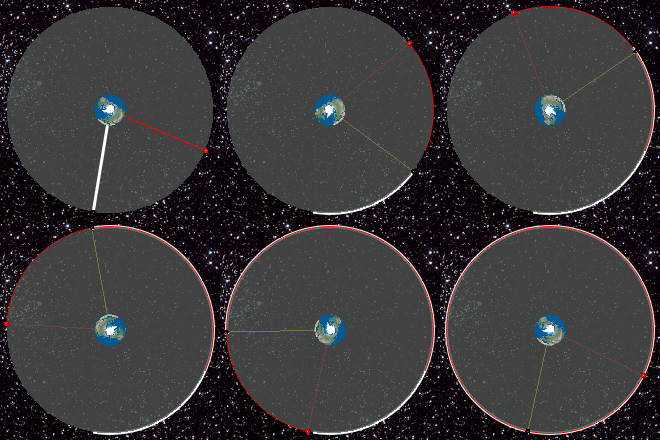
As such, the period when in will actually be in shadow is only a short period directly behind the planet.
Radiators in space work by radiating electromagnetic energy(light). Heat can only accumulate in matter, not in space, so that is definitely not one of the things we need to worry about.
Geostationary satellites are not standing still. They’re orbiting the Earth at the same rate that it rotates “beneath” them.
Super heat what in that space? The point is there’s nothing to transfer heat to. All you can do is radiate infra-red light.
Raditors. Starlink v3 can in theory already shed (edit 20) kW of heat. But they would need to figure out how to 5x that and keep things profitable.
It would be 20kW for each rack or two. The types of data centre deal they talk about these days are measured in GW of compute. That’s 50,000x just for 1GW.
The problems; plural; is that the person who popularized the idea of data centers in space has little to zero understanding of any of the space sciences and yet owns and directs one of the world’s largest, and privately owned, aerospace companies with massive government contracts that splits its time with their own AI work.
We already have data centers in space.
Oh? Good. Problem solved then.
User name checks out, though
How would you power them?
The surface area of solar panels exceeds the surface area needed for radiators to cool everything.
In space I would imagine you’d find the perfect sandwich ratio. One bun solar, one bun radiators, the meat being the racks.
only way it will be worth putting anything in space is by having a spaceport in there first and some reliable way to haul stuff from ground to it. At least way i see it, at the moment its like building a complex facility on an undiscovered continent with no support. But anything we put there shouldnt be privately owned anyway, or maybe that can be acceptable AFTER we have good and reliable infrastructure there which can deal with the bullshit that comes with privately owned stuff.
Maybe, the destruction of earth is part of the calculations. If earth is gone, space might be an option.
i dont think anything in orbit or space is supportable without a planet. Or at least it would take so much effort and skill to pull it off.
Or maybe the rich want to have kind of ultimate ivory tower -> they live in luxury in orbital habitats while we slave on the surface for them. Maybe they would want to get somekind of coercion method too, like nuclear arsenal in orbit they could use to threaten any part of the surface that might get too rebellious. At least i can imaging enslaving the entire planet would be something those psychos dream of.
Well, its not that i think this is what they are planning right now, but it wouldnt put it past them.
Wasn’t that the script of Elysium?
it was? havent watched it. I really hope it wont ever come to that, but knowing what those monsters do to kids it wouldnt surprise me if they wanted to make that movie into reality.
Kinda feels like at this point it’s not “if”. It’s “when”.
I said so long ago. Flying masses of stuff into orbit, keeping it alive in a relative high radiation environment, cooling issues (there is no local river you can conveniently turn into steam), the list is long. Getting free power from large solar panels does not make up for it.
Getting free power from large solar panels does not make up for it
For the power required “large” is actually a gargantuan understatement. It would need to be larger than what would be easily seen from the planet surface.
Elon is a complete moron.
Plus when you build a datacenter on Earth you can use it for decades. You can swap out small parts (like the servers and networking hardware), which keeps it useful. Cooling and power setups are often good for a very long time and those can also be upgraded if needed. The building itself and all of the supporting infrastructure is good for at least 50 years. And a lot of the building is dedicated to easy access for humans to do stuff like maintenance. This is a design requirement for any datacenter.
When shooting shit into space, that’s it, you can’t access it for upgrades or maintenance. And we’ve seen these past years cutting edge AI hardware is good for maybe 3 years at best. After that it’s basically worthless, maybe useful for some niche uses, but mostly useless and definitely not profitable. Not that this matters much, as to keep latency down the orbits would be so low they deorbit within 3-5 years anyways, like with the current Starlink constellation.
But this is of course very useful for a cheap launch provider, as it keeps them yeeting shit into space non-stop. And what a surprise, Elon Musk is one of the people pushing this concept hard. No alternate motives there for sure.
but mostly useless and definitely not profitable
The main reason for this unprofitability is, quite frankly, energy costs. Wouldn’t be much of an issue in space where your energy is free.
No such thing as a free lunch tho. It’s like saying solar energy on Earth is free, it’s obviously not. Sure, once the panels are produced and installed, the running costs are minimal. But that doesn’t mean that energy is now suddenly free. When I did the calculation on my solar installation, I took the costs of buying the panels, installing them, maintaining them and in the end tearing them down and properly recycling them. Then we calculated the estimated total energy produced during the lifetime of the system and thus arrived at a cost per unit of energy. Then we can compare that to what the cost would be as compared to other energy sources. At the time it didn’t make financial sense, as over the lifetime other energy sources (which might have been solar as well, just out of large scale installations) would be cheaper. But some government subsidies, plus a feeling the cost of energy in the future is unsure and wanting to contribute to sustainable energy production made me pay for them anyways.
It’s the exact same with launching a datacenter into space. Once it’s up there the energy might not cost anything and running costs per satellite might be relatively low (although there still are running costs for sure, often just spread out over the entire constellation), but that doesn’t mean the thing is free. Investers would want to see a return. So that means a lot of the costs are upfront, developing the system, paying the launch provider, getting the right licenses, etc, etc. Then during the lifetime of the system, it needs to sell the compute in order to make a profit. When directly competing with newer ground based systems that run cutting edge technology, it doesn’t really matter where or how the compute is done. It’s simply a unit of work being sold at market rate. Newer technology will push the price per unit down, as the new tech is more efficient. And it might make your compute less attractive as it’s lacking in newer capabilities, so it can only be sold at a lower price.
So even if the system would be designed for a lifespan of 10 years and put into an orbit that can last 10 years, the compute would be very hard to be sold for any reasonable price after 5 years. And as mentioned, operating a satellite is far from free, there are many running costs associated.
The thing is spacex’s whole falcon 9 architecture needs something to do. They very quickly cleared the backlog of satellites waiting to launch and now they’re waiting for space start ups to materialize and want to launch things into space. The majority of falcon 9 launches now only launch starlink. It’ll get even worse if they can make starship work, they’ll have a huge capacity with nothing to put in it. Ai data centers in space are an attempt at justifying the entire concept of starship or at the very least employ the falcon 9 team.
This and spacex going public tell me the return on investment of a space based internet provider maybe isn’t profitable enough to fund a rocket development program. Their big cash cow, being the ISS taxi, is winding down and now they’re looking for suckers with money.
If starship works (huge if) the markets it can open will be very different than the markets Falcon9 opened.
Something will need to develop around the new capabilities to use beyond their own use for starlink, but its going to be much easier for companies to come up with uses for it.
They make most of their money off starlink now, not ISS.
They’re a great idea if you happen to own a company making AI, a company making rockets, and a company controlling public opinion.
I envision a future so shitty that people are willing to physically destroy data centers in self-defense. Putting them in space is a really good way to combat that.
Putting them in space also puts them technically outside of the legal jurisdiction of any country. I figure fElon probably assumes that means said servers can never be subpoenaed.
Subpoena the ground stations if that was true?
Oh yeah it’s totally a bullshit argument, it wouldn’t hold water in any court. Hell if nothing else, the ground stations like you said, or the country whose airspace the center exists over, would be in jurisdiction.
But I do believe that Musk believes it’s a get out of jail free card.
Agreed. The US can access/subpoena any data it wants from US companies, even if the servers they host the data on are in Europe or Asia or…
It doesn’t matter where the servers and the data is located. It matters who posses (or controls the access) to it.
I mean a data center barge or one in Antarctica would do much the same and be wildly cheaper and (relatively) more practical.
But those aren’t as “cool”
Putting data centers in space is a good way to keep people from destroying them. Thermodynamics on the other hand, will have a field day with them.
Keep people from destroying data centers by having them destroy themselves? Is this some sort of zen koan?
Have to destroy the rockets that are used to maintain them then and just wait.
They aren’t maintained. They’re a constellation of small satellites in LEO like starlink that just go up and eventually come down.
If they’re too far up latency would be too high
Pastry in spaaace! Still, eventually they will stop working.
Wasn’t it recently proven that the metals introduced into the upper atmosphere by satellites burning up depletes ozone? Its not a problem yet but maintaining constellations on the scale of cumulative several gigawatts of data centre would leave several tons of satellite burning up every single day. CFC Ozone hole is gonna look like a cloudy day in comparison.
I don’t think anything was proven yet, but something came out saying it warranted more studying?
Satellites might need to be redesigned around it in the future and more studies should be done.
I just wanted to add another note
Even if this ozone thing turns out to not be true, there are still all sorts of other things being burned up in the atmosphere that can have other potential effects. It all needs to be studied given the size of these constellations.
I wouldn’t be surprised if 50-60 years from now, if there is a real issue, that it eventually comes out that SpaceX or other mega constellation companies figured out it would be a problem, and just said nothing. Much like how big oil new CO2 was a problem forever ago and hid it.
And an excellent way to scam a little. And fleece the flock
S o l a r. F l a r e
Also the whole being a vacuum thing makes heat dissipation much more difficult.
That’s an insightful way of putting it, 10 points.
Whatever happened to resource efficiency, being able to do more for less energy? This whole thing is super unsustainable.
Making reusable rockets is impossible and stupid. Electric cars are stupid and wont work. Satellite internet is too expensive and stupid. So far Elmo is batting 3 for 3 and I am going to bet he can make it work. Unlike the CyberTruck
none of these things “have worked” they just represent a privately subsidized shift in infrastructure and society. there is no such thing as progress, you progressive
gleaming eyes wide open
I am biased because I have starklink and love it. It works…but before Elon worked on his vision for re usable rockets it was a dream. He changed the world.
More nuanced (and without using the word “stupid”)
- Making reusable rockets is very difficult. It was high risk, high reward.
- Electric cars were always the climate change solution IF the battery gets good enough. And it got good enough. I hate my country’s car industry (I’m from Germany) for not getting their asses up.
- Satellite internet is in fact too expensive for average customers. I think, no on has ever declared it as bad for people in regions without existing internet intrastructure. The question is how profitable it is, but it’s not publicly traded, so we will probably not get the numbers.
For sure, Elmo can somehow make profit out of it, e.g. by selling the space cloud usage as “can’t be controlled by an government on earth” for a high price. But when we concentrate on the facts: It can’t be more efficient than Azure or AWS on earth, at least not for the next decades.
The Russians spat at his feet when he asked to buy their rocket engines, lots of naysayers. I have and love my starlink.
Just tell Elmo to add bigger CPU and GPU fans. That’ll work.
Well its a great ideal if you happen to be a company with a space program, sounds like a very lucrative venture.
The thing that people miss in this is that the feature they’re seeking by putting servers in space is only to have servers outside of any jurisdiction, with the advantages that it might bring
Imagine spending 10 years to build a server in space to avoid some law and next month government changes the law
This is 1 million% what’s at play here. Tech bros HATE that they have to deal with stupid laws, and putting a server outside of the jurisdiction of literally every country is a dream. A giant server ship has to dock, it needs fuel…not so with something in orbit (in Elon fantasy land anyway)
Now that is actually smart
Whatever company owns it will be responsible for it. That company will answer to whoever it needs to here on earth.
Wouldn’t it be cheaper to out it underground?
Also couldn’t power it with the sun. Which is infinite and free power
In either case the installation cost and infrastructure costs are excessive and the I/o is probably limited
cause of ping?
No, that works well with Starlink for example. But only because it’s in low earth orbit. In geostationary orbit You do in fact have a horrible ping.
Not being familiar with the details of this Elon brain fart I would hope they didn’t aim for geostationary… Because why?? Then again who knows with that idiot.
If it’s close enough for respectable latency, it’s close enough to experience drag. Given the maddeningly high power/cooling and resultant large surface area, then that satellite will have a tendency to incur re-entry.
So either close enough for “ok” latency but will burn up relatively soon or high enough to keep an orbit longer but terrible latency.
There’s nowhere to dump heat! Modern data centers rely on heat exchange systems that move excess waste energy into the air or earth. The servers will be thermally throttled to a crawl.
water cooling?
Sure you can have fancy liquid cooling to move heat away from the processors, but you still need something to move the heat into. You can radiate it into space, but not quickly enough to do useful work 24/7.
I was under the impressions cpu’s were very sensitive to radiation. If we could mine and manufacture in space I could see this maybe.
They already run AMD chips on starlink, so they’ve figured out someway to shield them in most cases. Some solar flares at bad times (something about while raising orbits) has nuked some dishes before.
Its probably cheaper to account for some expected losses, than shield them perfectly.
They’re shielded by being in a very low orbit. I don’t think that would work for a data center.
Im pretty sure they are shielded as I think I have seen stuff like that for the electronics in the iss. Thing is that the eletronics in sattelites and the space station are pretty small relative to datacenters. The only benefit I can really see is maybe they can be solar powered which I guess if the panel acts as shielding and stays sun facing but all the extra expense of getting it up there. I just don’t see it as practical. I mean technically it should either work or not basedo on cost as long as they don’t wring out any subudies or soemthing.
I think everyone is really confusing what these datacenters are.
They aren’t these massive things. They’re going to be a little bigger than v3 starlinks all working together in some manner. The best estiamte we have on size is v3 is 20kW of power, and these will be ~100kW
Edit: also power doesnt necessarily mean size. The GPUs will put off more heat per size i bet than whatever is in starlink, and even if it 5x’d the size of the computing area of the dish compared to starlink, that’s still tiny. It’s the radiator that will take up the space, not the datacenter portion.
ugh so we are talking massive constellations. That is so much worse.
It’s not speculation. Nvidia themselves have run experiments with GPUs in orbit, and the issue gets worse with smaller lithography (eg newer chips).
Spacecraft software engineer here:
They are and they aren’t. Radiation causes problems in terms of Single Event Upsets where a 0 turns to 1 and a 1 turns to 0 for a super tiny second. CPUs take some amount of time to let the transistor circuit stabilize before moving onto the next instruction so if an SEU happens in the beginning of this period it won’t have any downstream effects. Like a bump on the road.
Memory however is vulnerable to this tiny amount of time and can flip a bit to a different state than it’s supposed to be, but both are solvable problems with hardware and software based solutions, with ECC being the most common.
The other major problem is Total Ionizing Dose. Put silicon based semiconductors in radiation long enough and they will break down, and there’s no real hardware or software based solution to that. But it takes a long time
That is what I remember but it sounded like its a problem like that on earth with the massive atmosphere shielding and is exponentially worse in space.