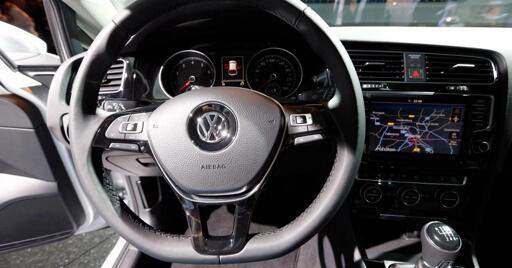
Volkswagen will restore physical buttons to the dashboard in its latest compact car, part of a wider move away from touchscreens.
In a particularly retro touch, the new ID Polo will even have a volume dial.
For a decade or so, automakers rushed to replace knobs and switches with screens, Autoblog noted in October, but users largely disliked them: Controlling the air conditioning, for example, required delving through submenus while driving, which was both difficult and dangerous. Research found that using touchscreens took longer and distracted drivers.
Hyundai, Mercedes-Benz, Porsche, and VW have all announced plans to return to more tactile controls, and US and EU regulators announced last year that cars with touchscreen controls could get worse safety ratings.
While I agree mechanical buttons are better for driving than a touchscreen, I think voice controls are better than either and prefer it.
“Car, help, I need the police”
“Sure. Now playing The Police.”
“Every Breath You Take” plays as you bleed out impaled on the steering column.
Do you have a “call police” button in your car now?
Yes, but I do drive a refurbished 1966 Batmobile and this comes standard.
While I haven’t compared recently, just a year or two ago, I was comparing usefulness of voice assistants with a co-worker. I experienced very accurate responses, whereas he found them useless. As someone speaking English with a heavy accent, the voice assistants could not understand him.
Voice assistants can be useful but there are still too many people who can’t use them
100% but every interface is going to have some level of exclusion & requiring more inclusive language models or better user onboarding to say some phrases related to specific commands can be required by regulation. I think probably the best imo is a voice interface that falls back to mechanical buttons if we’re trying to maximize usability and safety.
Time for some cassette futurism design!
8-track would be interesting. ;)
My pencil is ready
EDIT: This is not a euphemism
My PEN IS working.
Unironically I want this so bad, I’m one of those Gen Z guys who grew up around old tech but I love my clunky 1970s-1990s tech. There’s just something viserally satisfying about sloting in a tape.
I meant no irony either and I can point at one good reason for cassette futurism design: the soundscape.
I added a old radio with a Minidisk player into my car when the radio died
Fucken hell the fuck did you find a minidisk player? That’s unironically awesome, though whenever I see minidsiks I think of Starship Troopers.
Ebay, although it is a Japanese version of headset so you have to get a fm frequency shifter to make it work with US radio st
Hope our current car holds out long enough for those buttoned cars to arrive in the used car market.
Exactly what I’m saying.
Touchscreens in cars was a terrible development. The natural haptic feedback of physical buttons is a must, while operating a vehicle.
Touchscreens are wonderful in a car, just not for basic functionality. You can pry my Android Auto out of my cold dead hands.
The mini-map and cameras are nice on touchscreen too.
You can pry my Android Auto out of my cold dead hands.
Yes, that’s the idea after your distracted driving caused fatal accident. Exactly!
Not like I can watch movies on the thing, bub. It’s navigation and 99% of the time my audiobook player. Which, guess what, I control from my steering wheel. And it’s an audiobook. What’s there to be distracted by?
And it’s an audiobook. What’s there to be distracted by?
The audiobook? The answer was contained in your question. The result varied by type of drive though. They improve drivers during boring drives and well:
Overall, braking times to hazards were higher on the complex drive than the simple one, though the effects of secondary tasks such as audiobooks were especially deleterious on the complex drive.
I thought I saw another study some yesteryear about spacial reasoning tasks demanded by some audiobooks (describing a scene, what a building looks like, where it is etc) impaired spacial reasoning while driving. While music doesn’t use spatial reasoning hardly at at all. That’s why I stopped using audiobooks while driving, but I can’t find it so maybe I’ve been lying to myself all along.
The takeaway: boring drives secondary tasks could be good. Complex drives secondary tasks could be bad. I’ll stick with music but be more readily muting it for potentially interesting interactions. In a use the secondary task to keep focus and identify the hazard, once identified mute secondary task to react to the hazard.
But I play focus games while driving anyway. I don’t indicate out of habit: I reason if there’s someone to indicate to, then decide whether to indicate. I find it forces observations and space/speed reasoning to infer whether my changing direction presents a hazard to someone somewhere.
Phone holders are wonderful in a car. Get rid of the built-in touch screens entirely.
Phone integration with the car is handy. Bigger screen + integrated controls. I have volume controls on my steering wheel and a button to issue voice commands to Android Auto.
A $200 tablet and $50 holder is much more capable than the built-in touch screen. The built in touch screen is adding more $2500 to the price of the vehicle.
The built in touch screen is adding more $2500 to the price of the vehicle.
Others will say that touch screens are replacing physical buttons to reduce cost. So which is it? Touch screens add big cost or touch screens reduce cost?
/Not aimed at you, since you didn’t assert conflicting info
cost != price.
The costs involved with that touchscreen are in the tens of dollars, and much lower than the myriad physical hardware it replaces. The costs of producing the car are considerably lower. The price manufacturers charge for that vehicle are considerably higher.
Try to replace a defective touchscreen: the charge for the proprietary replacement screen is more than a flagship phone, but provides fewer capabilities than a budget tablet.
I recently fixed a phantom/ghost problem in my GMC acadia by replacing the touch glass for about $100. It was easy peasy. Had I taken it to the dealership, I assume it would have been a $1000 repair as they would have replaced the whole head unit rather than just the warped glass.
Then there’s me who disables that every time I get into a work car with it. I’ll just put my GPS in the cup holder, thanks.
Touchscreens are good for context-sensitive controls. They don’t make sense for basic controls that should always be available.
I’m fortunate that I have a good touchscreen for use with Android Auto + physical buttons for things like HVAC and volume.
You can have Android Auto without a touchscreen. My newish Mazda has joystick like controls for the screen.
Seems even more distracting than a touchscreen.
It’s not a joystick per se, it’s a tilting knob, kind of like a 3D mouse. Older Benz models had the same setup, it’s great.
Still requires you to stare at a screen while guiding a 3000lb slab of steel in public.
Up to a point. The rotation wheel has tactile feedback, it works really well in practice.
The Mazda rotary dial is awesome. It does 90% of what a touchscreen does, and voice control or a passenger can do the rest. If it can’t be done with three or four clicks of the wheel or Siri, then pull over safely and use the phone.
My old car had an aftermarket touchscreen CarPlay headunit, and I much prefer the buttons and dials on the newer Mazda. Borrowing somebody else’s (usually newer) car with a touchscreen feels like a massive step backwards.
Sadly it looks like they’re also falling for the touchscreen b.s. on the ‘26 year vehicles, big L for safety.
Yeah there is a lot of fuss about the cx5 turning to touchscreen and people hating it (in literature, not sure on the experience side yet). I have a 2020 and like the setup it has for sure.
Buttons that you can use without looking at them, please.
On my old car, the temperature dial had a notch, and you could set it to heat/cold by whether it was left or right of center, now it’s a free-spinning dial. Old fan control was a dial with stops, now it’s two buttons with no tactile distinction. Old vent selector was a dial with stops and I knew the foot/defrost setting was one from the top and the foot/body setting was one from the bottom, now it’s a single button same as the fan buttons that cycles through all the options. If I want to change anything, I have to wait until I’m at a red light or something so that I can look down and fiddle with it. I used to be able to do it all blind.
My car is like that, you can adjust temperature without looking at the screen, and the temp knob has detents every half a degree.
It’s good to see manufacturers going back to physical controls for key functions.
One of my cars has climate control with a knob, so I have to look at the (small) screen to see what the temperature is.
My other car has a hot/cold knob that I can just crank all the way to the stops. It even turns the A/C full blast on full cold.
I prefer the latter.
If you just leave the climate control set to a temperature that you find comfortable then the car will heat or cool as it needs to, to achieve that temperature.
I know cranking it over to hot or cold probably makes you feel better but it won’t make the engine warm up any faster or make the aircon cool any more.
Yes but I want the absolute maximum heat or cool it can provide, starting immediately. Even if the air coming out is only slightly warmer/cooler it’s still warmer/cooler.
I can always turn it down later.
It’s shocking how many otherwise educated people don’t understand how a thermostat works.
My understanding of climate control systems is that it does only provide maximum heat or cool. There’s a temperature sensor in the cabin that tells the car when it’s at the right temperature, but until that point is hit, it is heating or cooling as much as it can.
The only difference between climate control and traditional a/c is it knows when to stop and when to turn on again
Your understanding is wrong. I’ve tested the output air on both settings in the winter. Max heat had like a 30° difference. The engine doesn’t want to pull that much heat unless necessary because it reduces fuel economy when the block isn’t saturated. So unless you specifically ask for 110° air, it’s going to give you 80°
Most car ac systems are either on, or off. They don’t have variable compressor speeds. They cool at maximum until they reach the temp you set then they switch off. If the temp rises again then they switch back on.
A non EV cars heat is provided by the coolant that circulates through the motor. Nothing you can do will make the heater heat up faster.
Nothing I can do? If I drive my car at higher rpms, wont that make the engine hotter thereby also heating the coolant faster?
Yes that is true, I assumed everyone knew that 90% of engine wear occurs during the warm up period so you’d be foolish to ever run the car harder than needed in that period.
I was referring to turning up the heat to full or anything you can do in the cab as the poster seemed to think he could get more heat from the old analog systems faster than a standard climate control system.
In the old car, it was an analog system. These systems are digital in newer cars. So while you may get a knob or button, it’s still sending digital signals. That’s why there’s no distinction when you turn the knob, because there literally isn’t a distinction.
to be fair, it’s an encoder and the distinction is in the “direction” of turn. they could indeed make it both an encoder and tactile but where’s the profit in that?! :p
If they’re undoing changes that customers hate, maybe they’ll get rid of automatic stop-start too?
How does this automatic start stop work that you don’t like? And what brand of car is your experience with?
I have a VW ID.4 and I have no idea what you mean? If I use adaptive cruise control it will stop if the traffic stops, and it will start again automatically when traffic moves again. Working exactly as it is supposed to.
However if I don’t want that, I can touch the break at any time, which obviously disables cruise control, and release the break to roll slowly forwards like a traditional automatic in drive gear position.
Or if I hold the break for a short while, it will engage auto hold, and only go forwards again if I use the speeder.
Auto hold can be disabled if I don’t want it. But I like the feature, as I’m used to drive a manual.Everything works perfectly and intuitively, I’ve only had the car for a month, and it’s so nice to operate compared to an older car.
If I don’t want the adaptive cruise control, that too can be disabled, and it will work like a traditional dumb cruise control.
That’s not the feature they’re talking about.
Which I suspected, so I started out asking what the “feature” actually is!
Turns out it is NOT automatic start stop of the car, but of the engine. Very poorly formulated post IMO.
No, this is a feature that cuts the engine off when you’re at a stop. Then the engine re-starts when you try to accelerate again. Or if the AC needs to kick on. Or if the car needs literally anything. It’s jarring, and it’s little more than a gimmick that manufacturers used to improve gas mileage in testing.
And you know, reduce unnecessary emissions
I’ve yet to find any testing that would indicate it doesn’t work, only few where the effect has been quite small.
But even the tiniest effects become massive when multiplied by the amount of vehicles on the road. Like how turning your headlights off and using LED DRLs reduces fuel consumption by roughly 1-3%, which is quite a lot less pollution once you multiply that by the 250 million cars zooming around the EU and so on.
Stop-and-start systems usually result in a reduction of emissions somewhere between 3-10% in city traffic. That’s huge.
But because most people find it a tiny bit irritating, you are required the massive effort of pressing a button to turn it off every time. Most quickly realize it’s not all that irritating, because having to press a button to turn it off is actually more irritating, and so it stays enabled for a few hundred million cars reducing emissions.OK that’s very different from start/stopping the car, which is an actual function of modern cars. He should have specified he was talking about the engine.
I’m used to driving a car from 2008, but I borrowed a friend’s 2021 Subaru Forester and there the engine just shuts off after the car is stopped for a few seconds, even without any sort of cruise control. The engine turns back on when I let go of the brake, but I find the noise, the vibration, and the delay of the startups irritating. There’s no way to get the feature to stay off - it defaults to on every time the car starts and it will eventually turn back on while you’re driving even after you’ve pressed the button to turn it off temporarily. I find that especially irritating. (IMO it’s simply not OK for a car to do something after I’ve pressed the button telling it not to do that.)
Well IDK if VW is better in that regard, what I do know is that it’s to save fuel, and ICE cars are on their way out anyway. So it’s kind of a moot point to talk about improving on them now IMO.
Complaining about making less pollution. And demand improvements on ICE cars that are going obsolete.
Wake up FFS! This is not the 90’s.That was a federal regulation that Trump undid. Won’t get rid of it on your car, but it will for future cars.
Really? I wonder what model year will have cars available without it. I was thinking of buying a new car but I can wait.
So happy.
Thanks to these stupid fucking idiots we’ve now got 10+ years of used cars with HOT GARBAGE interfaces. Guess they learned their lesson eventually but the used market is screwed for a long time.
Before buying our latest, the family sat down and defined the minimum physical controls a car needs to have; functions that are used often while the vehicle is actively moving.
- Aircon
- Lights
- Cruise
- Media
Wipers, maybe. Automatic wipers are annoying, but deemed not a dealbreaker as long as the others above are present.
It was shocking how many makes/models did not even meet the bare minimum.
The new Toyota crown has lug studs. The vein in my forehead when I saw it
What the hell is lug studs?
Instead of studs that come out of the hub and a lug nut bolts down on the other side of the wheel, you have a threaded lugnut as one piece that bolts from the outside of the wheel into the hub. Less diy friendly imo and seems far less secure

It is maybe less DIY friendly because the wheel will not stay on the hub without at least one bolt inserted. Once you realize that’s the case, you put the wheel on and one of the bottom lug bolts maybe 2-3 turns in to prevent the wheel from falling off. I don’t see how they would be any less safe than studs and nuts. You tighten them to the appropriate torque spec and will never lose a wheel. The only other disadvantage I see is that you’re not gonna be able to easily fix badly damaged threads, but when and how would that happen?
Yes. Well with regular studs you can hang the wheel off the studs and it’s easy to line up. Also yes with studs you just replace the stud, with wheel bolts you’re tapping the hub to repair it or replacing the hub. It’s just enshitification to sell parts and laboris what I’m getting at
My car is 26 years old, with OE hubs and wheel bolts. My family traditionally had VWs; none ever had any issues with broken threads or bolts. I’m pretty sure that the approach works and has worked for many decades.
Well it’s dumb
Skill issue.
Yes, it’s called a wheel bolt. And they are much better than studs in every way. It’s why all the German brands use them.
Edit:
much better in every way
Yeah, no, eat a dick. Wrong
that’s why Germans use them
Ah yes the genius engineers that brought you the easy to maintain and repair: audi, vw and Mercedes. Germans do a lot of things right but cars are not one of them
I had a vehicle with the lug bolts, but it was more like an Allen key with the hex in the middle. Caused me all sorts of trouble when the head cracked while I was trying to change a tire.
Isn’t this fairly typical for Japanese cars?
No. European
Definitely not. I’ve worked on Mercedes, BMWs and VWs and they all had wheel bolts. I’ve seen plenty of Toyotas, Lexus and Mitsubishis with lug nuts though.
Finally undoing the damage to the design apple and John goingToSt Ives did.
If only we would also undo the other trends apple did, “Treating the customer like they are stupid”, walled gardens(we control your device not you) and everyone’a favourite: it’s in the store for 99cents
Edit: there’s a time and a place for multi touch, capacitive screens; it’s with unorthodox uis or things with a heavy emphasis on portability and video.
Blame Tesla for starting this garbage.
I think the Iphone came before the massive boost in tesla popularity.
But Tesla was the first to glue an iPad to the dash that does everything, because Tesla builds cheap crap and buttons cost money.
is that why my fucking electric hob has no buttons? no. the general wave that led to the fucking car having an Ipad was… the iphone
I swear I’ve seen an article like that every year for at least the last 4 years. It’s always about Volkswagen too.
The next generation of vehicles typically takes 4-5 years of design to be released, so I’m not sure what else you expect?
In a particularly retro touch, the new ID Polo will even have a volume dial.
This seems like a weird thing to mention because every stupid touchscreen car I’ve driven still has a volume dial.
It’s not, when many have buttons and not a dial, and the Golf Mark 8 specifically had two capacitive (IIRC) surfaces under the touchscreen.
Ja bitte!
Describing volume dials as “retro” is setting a very low bar for what can be considered retro. Also, it should have been super obvious to car makers from the start that using a touchscreen for almost everything was a really bad idea! As others have pointed out, you need to be able to control the car without having to take your eyes off the road for more than a couple of seconds.
Peak control design